Tuesday, June 29, 2010

Conference: "Being Europe: Crisis? What Crisis?" in Bratislava

GeoAIR's participation to Conference 28th – 29th January 2010
Space Gallery, Velehradska 7/A, Bratislava, Slovak Republic


The Heinrich-Boell-Foundation Brandenburg in collaboration with Space Gallery Bratislava kindly invites you to the conference

Being Europe: Crisis? What Crisis?


The conference “Being Europe: Crisis? What Crisis?” opens up new vistas on Europe 20 years after the fall of the Iron Curtain. Under the designation “Crisis? What crisis?” we bring into focus various perspectives on European changes in the last 20 years and the current crises. The title – taken from a cover of Supertramp's LP from 1975 – can ironically be interpreted in divers ways. For example as a synonym for a non-existing crisis or an attempt to disavow the existence of crises. It also describes the crucial questions for this conference: Are we really having a crisis? Are we even confronted with different crises? Or do we deny their existence and profoundness? What can we do to solve possible crises?
20 years have passed since the Velvet Revolution. Since then a globalized economy within a free society of politically responsible citizens seems to have grown. In these years societies in Europe came into transformation, new democratic systems have emerged and social reforms have passed. The European Union has fundamentally changed. At the same time it faces several crises. Some of them seem to be obvious. First of all a deep economic crisis. And also the crisis of climate change and energy resources which affect not only Europe but the whole world. But what about European culture and art? What about the crisis of the art market and the lack of support of culture and art in the new member states of the European Union? And do we also have a crisis of the democratic system? Sure enough democratic governmental institutions do not work efficiently in many member states of the European Union. The current constitution of democratic systems in European countries is confronted with a loss of political impetus. Public discussions of political issues seem to get less important. Most decisions are taken by only a few opinion leaders in national or supranational parliaments and governments. The level of participation of the citizens is low, their involvement in the process of decision-making weak. Nevertheless, political decisions taken today in times of crises will be eminently important for the future shape of our political, economical, cultural and ecological system. What Europe decides these days touches its being and the every day live of millions of people. Again: Crisis? What Crisis?

Monday, June 28, 2010

1st International Artist Initiatives Istanbul Meeting

From 2nd to 6th October GeoAIR / Archidrome participated at the 1st International Artist Initiatives Istanbul Meeting http://www.artistinitiatives.org./

The 1st International Artist Initiatives Istanbul Meeting was organized by Istanbul 2010 European Capital of Culture Agency in cooperation with Art Pie as a parallel event of the 11th International Istanbul Biennial, between 02nd-06th October 2009 in Istanbul 2010 Art Production Center Kadırga. It included discussions and presentations. The general aim of the meeting was to create a communication platform among artist initiatives from various European and other countries for sharing information, experience and best practices and in order to build new cooperations on the way to Istanbul 2010 European Capital of Culture.

GeoAIR / Archidrome was presented by Nini Palavandishvili


video by Stina Pehrsdotter
http://www.pehrsdotter.se/

Friday, March 13, 2009

Reciprocal Visit

Panel - Impacts on the growing networking in the region
Eva Khachatryan, Serra Özhan, Nini Palavandishvili
21 November 2009, 16:00, Tütün Deposu, Istanbul


ორმხრივი ვიზიტი
ორმხივი ვიზიტი არის Apartment Project-ის (სტამბული) დამფუძნებელი მხატვრის სელდა ასალის იდეა. პროექტის ორგანიზატორი და კურატორია სერა ოზჰანი.
პროექტი სათავეს იღებს თურქეთიდან და გრძელდება საქართველოში, სომხეთში, აზერბაიჯანსა და ირანში. პროექტის მიზანია, რომ ამ მოგზაურობის რდოს, თვითოეულმა მონაწილემ თავისი გშთაბეჭდილება აღწეროს თავისივე სიტყვებით და ნამუშევრით. მხატვრები ერთმანეთს გაუზიარებენ მოგზაურობის დროს მიღებულ გამოცდილებას და შთაბეჭდილებებს. მონაწილე მხატვრები მასპინძელ ქვეყნებში გაიცნობენ მხატვრებს, მწერლებს და ჟურნალისტებს და ამ ქვეყნებში სამ დღიანი მუშაობის შემდეგ მოაწყობენ ნამუშევრების ჩვენებას და დისკუსიას. ეს დისკუსიები შექმნის პლატფორმას შემდგომი თანამშრომლობისა და გაცვლა-გამოცვლისთვის.


(English version below)


პირველი ნაწილი 1-17 აპრილი 2009
პრეზენტაცია თბილისში, 4 აპრილს 19 საათზე. მისამართი: აბრეშუმის მუზეუმი, ცაბაძის 6. საქართველოში პრექტის პარტნიორია გეოეარი (GeoAIR)

პროექტი სათავეს იღებს თურქეთიდან და გრძელდება საქართველოში, სომხეთში, აზერბაიჯანსა და ირანში. პროექტის მიზანია, რომ ამ მოგზაურობის რდოს, თვითოეულმა მონაწილემ თავისი გშთაბეჭდილება აღწეროს თავისივე სიტყვებით და ნამუშევრით. მხატვრები ერთმანეთს გაუზიარებენ მოგზაურობის დროს მიღებულ გამოცდილებას და შთაბეჭდილებებს. მონაწილე მხატვრები მასპინძელ ქვეყნებში გაიცნობენ მხატვრებს, მწერლებს და ჟურნალისტებს და ამ ქვეყნებში სამ დღიანი მუშაობის შემდეგ მოაწყობენ ნამუშევრების ჩვენებას და დისკუსიას. ეს დისკუსიები შექმნის პლატფორმას შემდგომი თანამშრომლობისა და გაცვლა-გამოცვლისთვის.

მონაწილე მხატვრები თურქეთიდან: ენდამ აჯარი, სელდა ასალი, ვოლკან ასლანი, დენიზ გული, ფატმა ჯიფთჯი, ზერენ გოტკანი, გოზდე ილკინი, ჯერან ოუკიტი, გოცკე სუვარი და სოფო ტაბატაძე საქართველოდან

მეორე ნაწილი
17-31 ივლისი 2009 საპასუხო ვიზიტი და ერთობლივი მუშაობა გაიმართება სტამბულში Tütün Deposu-ში .

პრეოქტის მეორე ნაწილში, მონახულებული ქვეყნებიდან ორ-ორი მხატვარი საპასუხო ვიზიტით ეწვია სატმბულს სადაც გაიმართა ერთობლივი შემაჯამებელი მუშაობა.

ეს მხატვრები არიან:
ნადია წულუკიძე და სოფო ტაბატაძე საქართველოდან, სონა აბგარიანი და წომაკ ოგა სასომხთიდან, ალი ჰასანოვი აზერბაიჯანიდან და შაჰაბ ფუტუჰი ირანიდან


პროექტი დასკვნითი გამოფენა 2009 წლის 14 ნოემბერიდან- 19 დეკემბრამდე გაიმართა სტამბულში DEPO-ში.

DEPO არის კულტურული პლატფორმა დებატებისთვის ხელოვნების და სამოქალაქო საზოგადოების საკითხებზე. მისი მიზანია თანამშრომლობის დამყარება კულტურის დარგში თურქეთს, სამხრეთ კავკასიის, აღმოსავლეთ ევროპასა და ბალკანეთის ქვეყნებს შორის.


Reciprocal Visit
Reciprocal Visit is project by Apartment Project in Istanbul . This project is associated with the work of the visual artist and the founder of the artist initiative Selda Asal who is the originator of the project’s concept. The project is organized and curated by Serra Ozhan.

Iade-i Ziyaret / Reciprocal Visit was an experimental workshop project made up of photographs, videos, writings, interactions, and talks by participants from a variety of disciplinary backgrounds such as photography, video, music, performance, painting, sociology. It took its name from the culture of ‘reciprocal visit’ that is alive and well in Armenia, Iran, Azerbaijan, and Georgia as well as in many Arab countries and Turkey. This project is called ‘iade-i ziyaret’ because it consisted of one group visiting Iran, Azerbaijan, Georgia, and Armenia and of the reciprocal visits of two artists from each country visiting Turkey for the second part of the project. This oncept that is familiar to both the artists from these countries and to us. It’s a concept that connects.

Part One

Travel: 1 - 17 April 2009. (Presentation of the project in Tbilisi
04.04 2009 at 19.00 at State Silk Museum
Address: Tsabadze Street 6)

Participant artists: Endam Acar, Selda Asal, Volkan Aslan, Deniz Gul, Fatma Ciftci, Zeren Goktan, Gozde Ilkin, Ceren Oykut, Gokce Suvari and Sophia Tabatadze.


The artistic material was created while participants were on the road, at places where they stopped, visited, or staid.

The route of the workshop, part one took off in Turkey and went through Georgia, Armenia, Georgia again, Azerbaijan, Iran and Turkey. The aim was to let each participant describe his or her experiences in his or her own language. This was to reveal different kinds of language that could be generated within the shared work time in a mobile space serving as a workshop area during a 15-20 hour work schedule. Performing these activities the individuals in the group emphasized different aspects of different things they saw or the same thing they all observed. After each 3 days of intense work in each main town there was an open discussion evening accompanied by a screening. This provides space for artists’ meetings to discuss further collaborations.

Part Two

17-31 July 2009 Tütün Deposu - DEPO (former tobacco warehouse), Istanbul.
The second part was the final joint work created on the basis of reciprocal artists’ visits to Istanbul. These artists were the ones who have been visited and worked together in their own countries (Azerbaijan, Georgia, Iran, Armenia) in April 2009.

Participants of part two:
Sophia Tabatadze and Nadia Tsulukidze from Georgia, Sona Abgaryan and Tsomak Oga from Armenia, Ali Hasanov from Azerbaijan and Shahab Fotouhi from Iran.


The completed project was presented in DEPO. It opened on 14th of November 2009.
Exhibition dates: 14 November – 19 December 2009.

DEPO is a cultural and critical debate center that functions as a platform for artists, civic and cultural organizations in Turkey, the South Caucasus, the Middle Eastern and Balkan countries. It objective is to facilitate artistic collaboration and cultural exchange and to stimulate reflection on social and political issues relevant for the region.

Sunday, November 02, 2008

Exhibition of Salome Machaidze

18-23 October 2008

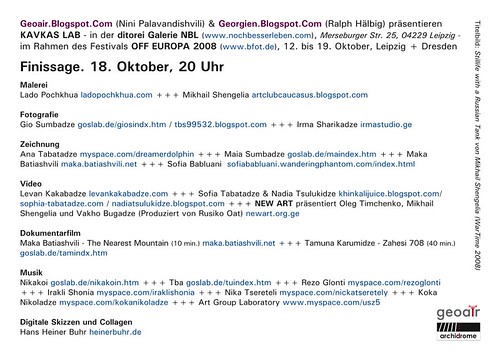
Exhibition of Salome Machaidze (delikatessenhaus.com) & Kavkas Lab with Georgian Artists (ditorei Leipzig)
Both exhibitions were organized for the Theatre Festival OFF EUROPA in Leipzig.


No comments:

Saturday, February 02, 2008

Exchange Academy

02-23 April 2008, Tbilisi, Georgia


Concept and organization GeoAIR, Georgia:
Freya van Dien (NL); Onno Dirker (NL): Sophia Tabatadze (NL/GEO)

Participating Artists:
Vahram Aghasyan (ARM); Can Altay (TR); Onno Dirker (NL); Ergün Erkoçu (NL); Peter Zuiderwijk (NL); Kote Jincharadze (GEO); Kote Sulaberidze & Nino Chilashvili (GEO); Sophia Tabatadze (Geo/NL); Lado Darakhvelidze (GEO).

Participatants from 'Archidrome' - Contemporary Art Archive, Georgia
Nini Palavandishvili; Ani Chorgolashvili; Lali Pertenava; Sophia Kilasonia; Sophia Tabatadze.

Participant from State Silk Museum, Georgia
Nino (Chuka) Kuprava

During three weeks in April 2008 a group of Georgian, Dutch, Turkish and Armenian artists created platform for exchange of information, brainstorm sessions, group and individual projects and research on and around the theme: contemporary art archive. This project was realized in collaboration with the team of Georgian Contemporary Art Archive ‘Archodrome’ and took place in the Silk Museum in Tbilisi. At the end of the working period of three weeks, final exhibition titled ‘Re-Opening of Silk Museum’ was opened for to public.

To avoid the known setting of the artists being invited somewhere distant place for short while, in order to produce quick work that concludes into an exhibition, of which not much remains after the departure of the artists, we decided to go the other way and change the setting. Suggestion was that the invited artists would work on a real problem that is present in Georgia, namely lack of archive or a base where the information and experience about contemporary art can be brought together. This information can have various forms, including collection and registration the projects like ‘Exchange Academy’. Thus the question was to think of ‘archiving’ the project like we were part of as a process of the project itself.

During the project public and art sector of Tbilisi were involved in the project through public lectures and talks by: Maia Mania (Geo); Khatuna Khabuliani (Geo): Nana Kipiani (Geo); and Nathaniel Mc’bride (GB).

Vahram Aghasyan (ARM) and Can Altay (TR)
organized artists’ talk in collaboration with ‘Archidrime’ ‘Archidrome’ - Contemporary Art Archive, Georgia


Project was support by:
Stroom, the Hague (NL); NCDO (NL); Step Beyond, European Cultural Foundation (NL).

Read More>>

Thursday, April 19, 2007

Dance Films Screenings

Program from 22 March to 24 May

Goethe Insitute Tbilisi, Zandukeli street 16

Nadia Tsulukidze organizes dance films screenings with disscusions, presenting concepts and ideas of Chorepgraphers from German 'Ausdrucks Tanz to 'Tanztheater', American Modern and Postmodern Dance.


Monday, April 02, 2007

Onno Dirkers residency in Tbilisi.

Cultural Agenda Tbilisi, project by Onno Dirker, design Nini Palavandishvili


------------------------------------------------------------------------------------


  • Tape to mark an area for the project 'A home for the ones without a roof' (Huis van daklozen)
Between the 4th of april and the 12th of may the Dutch artist Onno Dirker did individual residence in Tbilisi. GeoAIR invited the artist because of his strong engagement with and interesting projects about societal issues. For those of you that read Dutch: www.dirker.nl & www.atelierveldwerk.nl When Onno will be posting his experiences in a blog that you can access through the GeoAIR blog. You can download a pdf file with documentation of his projects in English HERE.

Onno Dirker is interested in ‘situations under pressure’ and the position art can take in these situations. Some of the themes and methods he works with are: the sociology of urban design, the relationship between east and west, human routines, cultural and urban analysis of neighbourhoods through the perspective of art. His work and way of working is engaged and enthusiastic and he has realised many successful projects. The Georgian context suits Onno Dirkers interests and we think that his energetic and engaged attitude will lead to a fruitful residence.

Sunday, March 11, 2007

BlogShop

'The BlogShop’ 9 November 20:00, location: Goethe institute Sandukeli Str. 16.

During the Art Caucasus there has been lot of talks about networks, art off course, idea's about what kind of art projects Tbilisi needs, about the lack of a critical discourse in Tbilisi and many more related subjects.
A lot of these talks took place in kitchens or in restaurants etc. and usually in small groups of people. There was a lot of engagement in these conversations and good idea's being articulated. A subject that often came up is the a lack for a platform where this engagement and the idea's can be shared and several foreign visitors said: 'there is so little information to be found on the internet about the Georgian art scene'.
Together with the French art lover and professional website and blog user Audrey Bartis we have discussed the possibility of making a network of blogs connecting the Tbilisi/Georgian art scene and make it visible on the internet.

What is a blog?
A blog is a free place on the internet that anyone can crate and fill with images and text about whatever he or she wants to show on the internet. A lot of people use it as an alternative for a website because it’s for free and very easy to make, keep updated and link yourself to others that share your interests.

The 9th of November we organise a BlogShop in which we will show how a blog functions, how you can make one and how a group of blogs linked together can make the Georgian art scene more visible on the internet and contribute to the strengthening of a local and national network.

Hope to see you there.
Best regards,

The GeoAIR BlogShop team: Freya van Dien, Sandro Chaidze, Sophia Tabatadze and Nadia Tsulukidze.

Monday, January 29, 2007

Tamuna Chabashwili (Geo/NL), Artist's talk about PSWAR and 'Beauty Unrealized' project

PSWAR /www.pswar.org/ is a collaboration of the artists Tamuna Chabashvili (Georgia, 1978), Adi Hollander (Belgium, 1976) and theoretician Vesna Madzoski (Serbia, 1976) whose activities go beyond the usual notions of artists-as-social-activists, artists-as-producers, and artists-as-curators, blurring the borders between many roles assumed to be taken by the present-day artists. Their projects are based on research and include several levels: examination of collaboration and collective action, the possibility to use existing artworks as ready-mades, questioning of the existing exhibition formats, creating platforms for intimate and individual experience of the artworks and changing perception of the space.


Beauty Unrealized
A research project conducted by Public Space With A Roof
***


In the last few decades beauty has been a much disputed term. It has often been associated with things ornamental or decorative, while simultaneously becoming the buzzword for conservative critics who object to anything avant-garde. Perhaps because of this stereotypical understanding and misuse of the term, 'beauty' has all fallen out of favour within present art discourse. With this project, we want to underline that (produced) objects are equally important as 'social projects'. Since people have always communicated through objects in space and time, it is important to discuss the link between objects and ideas, or more specifically, between objects and the concept of beauty. Invited artists, composers, film directors and philosophers will explore the concept of beauty today within the scope of their own process of self-development and their own work. As a framework for the whole project, we created a special library in which visitors can enter and get lost in the world of thoughts, ideas, questions, possibilities, and puzzles.


For detailed information you can visit the PSWAR web site:
www.pswar.org


Tuesday, December 12, 2006

Kirsten Leenaars (NL), 'Dreams of others' 2006-07


Kirsten Leenaars:
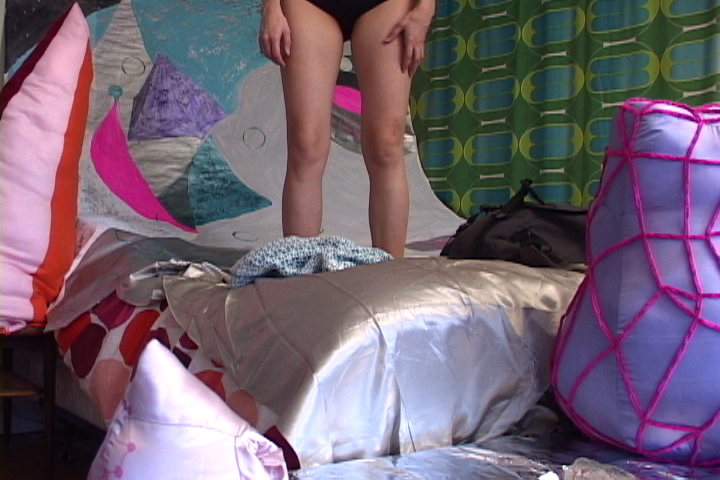
'In my work I explore how identity is constructed, how we look at ourselves and consequently at others. As an artist I work mainly in video and photography. I am interested in how the camera can play an active role in the constitution of its subject, questioning my own role as an artist within the traditions of presentation and representation. I often use my work as a ‘platform’ for other people where they can perform themselves. In the project “We are our dreams of ourselves souls by gleams And each to each other dreams of others’ dreams” (May 2006)

I looked at aspirational dreams as imagined spaces where personal circumstance and desires intersect. I asked people about their aspirational dreams and in the end to play themselves in their dreams. The dreams are filmed in each participant’s own living room, functioning as the symbolic framework that defines each one of them. I used objects that were already part of the space and used painted backdrops to assist in the execution of the dream. The dreams in this project are my translations of their dreams into video. I would like to develop a Georgian addition to this work. It is especially exciting to me to develop the counter part for my project in a nation that is going through a time of transformation. Now that new opportunities have opened up and old safety nets are disappearing I think it is particularly interesting to ask people about their aspirational dreams. I am very curious as to how the Georgian dreams will relate to those of my American participants, living in the so called ‘land of opportunities’. The Georgian addition to my project will be shown in Chicago at Gallery 400 in March 2007'.

For detailed information please visit: www.kirstenleenaars.nl

Tuesday, November 21, 2006

Rosell Heijmen (NL), 'The Very Temporary Contemporary Museum', 2006-07


At the end of 2006 I visited Tbilisi in order to start preparations for a publication about Arts and Culture in Tbilisi, in collaboration with GeoAIR. As a guest in Goethe Institute I was invited to make an exhibition in this period. The first step was to talk to young artist about their art-practice and the possibilities to show their work, hoping to see a lot of work in the process. Soon it became clear that the only possibility to see work by young artists is through looking in a catalogue, magazine or visit the artists in their home. This was my third visit to Tbilisi and unfortunately during all of these visits, I was not able to see the works of fellow (living) artists in an exhibition context. However there are a number of very interesting initiatives, art-collectives and persons that try to change the situation and focus on developing their works. I was lucky to have met a number of artists through GeoAIR and because of a prior project in Tbilisi called 'Georgia Here We come' (with an exhibition in the National Art Center that unfortunately seized to exist) in Spring 2006, that enabled me to get some insight in the Georgian Art scene.

There are a great number of museums in Tbilisi, most of them have an exceptional collection, a beautiful building, a large staff, and a lot of free space. Next to these exhibition spaces there are a number of private owned Galleries. None of the exhibition spaces offer contemporary artist a place to experiment, because there is no focus on modern art and the actual space is to be left intact. A few of the bigger museums are being renovated. In Tbilisi renovation can mean a number of things: The national museum on Rustaveli is indeed being renovated, new walls, new floors, new light, new division. It can also mean simply closing a part of the museum and leave it unused for a long period of time. The only 'lively' exhibition spaces and spaces for workshops, lectures and discourse seem to be foreign institutes like The British Council and The Goethe Institute. However their policy is to promote and develop their specific culture, respectively United Kingdom and Germany, it is mostly artists from these countries that have a chance to work there.

There are a lot of empty buildings and a lot of empty space in the museums in the city and there are a lot of plans to realize a contemporary art-space in Tbilisi, however the buildings will probably remain empty for a long time. A lack of flexibility and willingness (support through facilities, permissions etc.) from the part of the city council, the Government and the institutions make it very difficult for the artist to follow through on developed initiatives to realize serious projects without financial means. There is a lot of concern, talk and frustration about the situation, but due to lack of financial means and difficulties in working together, a place for showing, meeting and discussing, seems to be far away. There is hardly any government support, there is practically no art-market or government assignments for contemporary artists.

In contrast to the absence of a functioning presentation space, there are a few very interesting magazines that focus on contemporary art, photography, design, fashion, music, architecture and literature called Anabechdi, Hot Chocolate, a periodical by AIRL, and Loop'A. The magazines offer alternative possibilities for artist and designers to show their work. The first three magazines are in Georgian only, which is a pity for non-Georgians to get an insight in the Georgian contemporary art-scene.

In the Goethe Institute I wanted to show this situation and make a work in-situ. I ended up showing and feeling the situation, by experiencing some difficulties involving making an exhibition. Together with Lado Darakhvelidze and Giorgi Tabatadze I work on an installation based on the reality for artist to develop their art-practice and the lack of exhibition space. We divided the space in a classical museum space and two small museums. The classical space showed pictures of the interiors, taken in all the major museums and other art-spaces in Tbilisi. In the two small spaces Lado Darakhvelidze and Giorgi Tabatadze made a translation of their exhibition possibilities, they showed their work as it actually can be seen; in their house. By making this exhibition I was confronted with the Georgian reality. Until this time I did not actually understand what it is to deal with bureaucracy and hierarchy. The coarse of action is different, you need a different mind-frame to realize an exhibition especially in a short time frame. Even in the German Goethe Institute flexibility and support was hard to find. In order to get something done, even small things, heaven and earth were to be moved. The invitation to make this exhibition was there, but it seemed like an actual interest and commitment to realize this exhibition was absent. After having started to build the exhibition it became clear that the institute's interest was in a formal exhibition, framed pictures an occasional sculpture, no sound, no work, no fuss, nothing exceptional. With a small budget, a good concept an actual space, and a cooperating staff one should be able to work magic. With a good concept, an actual space, a small budget, and an unwilling director, everything works a lot slower and takes a lot of energy, creative process stops right there.

At the same time, Tbilisi art-scene is interested and interesting.
Whenever there is a exhibition or an action, there is a large group of visitors, big interest by the media and a lively discourse. For me this goes to show that the so much desired contemporary art space is of utmost importance for visitors and artists and it will work. With this potential and a lot of work remained unseen, it's not obvious why this space doesn't already exist, one could imagine that an unused building, made available by the city council, could easily be transformed.

Monday, November 06, 2006

Jasper van der Made

In February-March 2006 Jasper van der Made (NL) stayed in Tbilisi. During his stay he made the work Coca-Colonization which was shown in the Gallery Didi in Tbilisi.


Coca-Colonization

Friday, October 27, 2006

ABOUT: Caucasus Biennale Declaration (18 – 22 October, 2006)


By Nathaniel McBride

Much of the best work at Art Caucasus Declaration, Tbilisi’s prolegomenon to its first biennale next year, was to be found in Teppanyaki, a group show held by students and teachers from the city’s Art Academy. Here the exhibiting artists had agreed to produce all their work, in the manner of sushi chefs, on the opening night and in the presence of the gallery audience, thereby placing upon themselves tight restrictions of space, time and material. The most successful pieces worked through, rather than in spite of, these limits, making a virtue of simplicity, exploiting obvious affinities with performance and employing an aesthetics of the bodily trace or imprint. George Kevle’s Three Stains consisted of three abstract forms painted directly onto the gallery wall using his own blood mixed with that of an AIDS sufferer’s; the sense of vague apprehension this produced seemed to offer a modern substitute for the ‘aura’ that Abstract Expressionist painting once sought to achieve through purely formal means. In Through my Mouth, Giorgi Marr stuck pieces of chewed chewing gum to the wall in four rows extending from floor to ceiling, thus turning the decorative coloured candy into something simultaneously attractive and repulsive, its bright hues and fragrant scent contrasting with an awareness of the litres of spit and many man-hours of mastication were required to fix it there. Elsewhere, Elene Naveriani and Vajiko Chakhiani gave performances that produced a steady accumulation of lipstick prints and cigarette butts respectively. All these works spoke of monotony, but a monotony measured out in a series of tiny pieces or traces of a body slowly expended or used up, each one becoming a metaphor of gradual and inevitable physical dissolution. Thus their apparent playfulness often concealed a deeper seriousness - an underlying awareness of life’s finality, and the insistence upon this awareness as a precondition to being properly alive.

This aesthetic of the body’s trace was developed the following week in two performances at Tbilisi 3: Let’s Stay Alive til Monday, a group show of western and Georgian artists organised by the Swiss curator Daniel Baumann. Gela Patashura’s Untitled, in which the artist sat in a steam-filled glass cube writing messages on its walls that were almost instantly effaced by condensation, enacted a recurrent theme in Georgian art - the failure of communication, where the artist’s repeated messages to the ‘outside world’ are either lost, ignored or wilfully misunderstood. Kevle’s piece for this show involved him extracting half a litre of his own blood and then inviting a curator and a critic to cover the wall behind him with it. The blood was smeared in outline around the artist’s cast shadow and then outwards in a growing red aura that literally traced his absent presence on the gallery wall. The symbolism of the artist’s blood being manipulated by two traditional hate figures of the art world was lost on no one: more interesting, perhaps, was the reaction of a public still relatively new to performance art. The act of making oneself vulnerable is always also an aggressive one, and reactions to this aggressiveness naturally varied. But even the most hostile seemed to acknowledge its inherent attractiveness, in the guilty enjoyment of a shared complicity and the illicit participation in a collective guilt.

......................................................................................

By Aleksandra Galkina

Казус биеннале

Казус биеннале
В октябре этого года в Грузии состоялась международная выставка «Кавказская биеннале – Декларация», которая заявлена составной частью Кавказской биеннале, планирующейся в 2007 году. Лейтмотивом многих работ, представленных на выставке, так или иначе, является «изменяющийся мир» в смысле его социополитической трансформации во времени. Однако за немногими исключениями искусство, представленное на выставке, похоже на то многое, что сейчас представляется как «искусство постсоветских стран». Претендующее на роль современного и имеющее амбиции в области сложившегося художественного контекста, оно зачастую спекулирует на «базовых ценностях» (национальных, религиозных), тавтологично размещая себя на периферии глобального художественного процесса. Но это впечатление – скорее вина организаторов таких выставок, недостаточно внимательно и вдумчиво подходящих к работе с локальными художественными контекстами.
Это уже не первый опыт «больших проектов» на Кавказе. Автором и организатором «Декларации» является Южно-Кавказская региональная Ассоциация «Арт-Кавказ» (Грузия, Армения, Азербайджан), 3 года подряд проводившая международные выставки-ярмарки, и декларировавшая тогда своей целью «формирование арт-рынка Южного Кавказа и создание сильной и координированной структуры арт-бизнеса в регионе». Факт биеннале - в большей степени факт государственного значения. Таким образом, инициатива, изначально нацеленная на развитие арт-туризма, обретает вполне завершённую форму идеологического проекта.
Постепенное включение в мировой художественной контекст стран т.н. постсоветского пространства давно уже очевидная тенденция. На выставке в Тбилиси было представлено в основном искусство стран Южного Кавказа (а также Украины, России, Германии, Турции и Ирана). Выставка состояла из нескольких частей – непосредственно экспозиции в трёхэтажном здании Детской национальной галереи, конференции на тему «Искусство в изменяющемся мире» и мастер-классов иностранных кураторов и художников. В частности, небезынтересной была лекция куратора Антонио Джеуза, посвященная русскому видео-арту, проведённая в местном Гёте институте. На примере работ Бориса Юхананова, «Новой Академии» («Пиратское телевидение»), группы «Синие носы», художников Гии Ригвавы («Они всё врут»), Антона Литвина, Анны Ермолаевой, КД, а также редких и мало кем виденных даже в Москве видео Андрея Монастырского «Разговор с лампой» Антонио проследил развитие этого жанра в России.
Экспозиция в Детской национальной галерее была поделена по странам, представленным художниками-участниками и тематическим проектам. Один из залов занимала выставка “Экотопия, современное искусство и экология в Закавказье”. В ней приняли участие художники из Грузии, Армении, Азербайджана и Германии. Пафосом выставки должен был стать прецедент сотрудничества современного искусства с экологией. Как объясняет искусствовед Хатуна Хабулиани, экологические темы в традиционной грузинской живописи – предмет эстетизации, «ландшафты и натюрморты служат колористическим задачам», а для советского периода природа была скорее безопасной темой, где авторы чувствовали себя защищённым, избегая спорных вопросов (классические примеры живописи Пиросмани и концептуальных ландшафтов художника Давида Какабадзе). Выставка включает как отдельные работы, так и запись интервью с художниками, комментирующими свои работы и предлагающих собственные проекты по улучшению окружающей среды властям. Нино Сехниашвили озабочена проблемой растущей радиации, она предлагает измерить степень радиации в художественных галереях разных стран и сравнить её. Художница Софо Табатадзе говорит о мусорных свалках, которые в Грузии можно встретить и у фешенебельных вилл, владельцев которых не смущает такое соседство и им безразлично, что творится за стенами их владений. Ещё один респондент фильма – скульптор Мамука Самхарадзе -обеспокоен недопустимой, по его мнению, близостью озера Лиси (Тбилиси) с жилыми кварталами. В фильме есть фрагмент его перформанса - «медитации в танце» у этого озера. Как отметила Ева Хачатрян в сопроводительном тексте к армянской части экспозиции «Экотопии», остаётся вопросом то, может ли искусство выполнять «инструментальную» функцию по отношению к социальности, или нет.
В рамках этих рассуждений интересным представляется проект, представленный на выставке в Тбилиси грузинским куратором Георгием Кевле. В прошлом году на очередном «Арт-Кавказе» им была организована выставка «Другой Кавказ». Сейчас он представил наиболее удачную экспозицию во всей «Декларации». Она называется “Teppanyaki”. В каталоге, составленном, кстати, целиком на английском языке, в духе «а почему нет» дано краткое объяснение, содержащее цитату из википедии (сетевой открытой энциклопедии). Teppanyaki – японская кухня, в которой всё готовится на специальной большой сковороде. В середине 20 века Teppanyaki, популяризированное в Америке одной сетью ресторанов, приобрело новое значение – так стал называться зрелищный процесс приготовления блюда в японской кухне. Это и имелось в виду авторами. Здесь можно угадать иронию над «шутовским» поведением страны-периферии перед центром-монополией в политике (культурной, в частности).
Все работы в экспозиции - результат перформативных действий на месте, что концептуально перекликается с её названием. По технике исполнения все они отличаются лаконичностью и простотой. На одну из стен грузинским художником Melano было нанесено крупное пятно нефти, формой напоминающее цветок, – работа “Oil flower”. Следом на двух расположенных по горизонтали выступающих из стены прутах было натянуто предварительно смоченное в зелёнке и затем скрученное во много раз полотенце. Площадь вокруг объекта осталась забрызганной зелёнкой (Condition 8, художник Gago, Грузия). Другая работа Stain 1,2,3 – три небольших пятна бледно-красного цвета – в технических данных которой указаны «кровь, заражённая СПИДом, кровь овцы, пятно краски» (Giorgi Kevle, Грузия). Работа Through my mouth – 4 параллели вертикальных рядов разноцветных жвачек, каждую из которых художник Giorgi Marr разжевал и приклеил к стене.
В целом проект Teppanyaki по форме вполне убедителен. Однако общее впечатление от выставки «Кавказская биеннале - Декларация» замутняется экспозиционной невнятностью. Значение подобных выставок в локальном и международном контекстах если не иллюзорно, то сомнительно. Безусловно, выставка «Декларация» и заявленная на следующий год Кавказская биеннале должны оказать некоторое влияние на ландшафт местного культурного контекста (туристический интерес к региону вырастет наверняка), но на международный рейтинг художников – вряд ли.
Александра Галкина
2006


.

Александра Галкина

2006

..........................................................................................

By Freya van Dien


The Art Caucasus 2006; Caucasus Biennale Declaration. What’s in a name?


If I were to ask someone who had neither seen nor heard of ‘The Art Caucasus 2006; Caucasus Biennale Declaration’ what kind of project or presentation they think it could be, what would they say? What do the words ‘art’, ‘Caucasus’, ‘biennale’ and ‘declaration’ stand for?

Let me start by tackling the most difficult one: art. Art, to me, is a form of human expression that represents or presents this ‘stranger than fiction’ world of ours in ways that make us realise the immense diversity in which it can be experienced. Art also shows us the uniqueness and talents of human beings who choose the life of an artist and put themselves under the pressure of always questioning oneself and the world around them in order to keep their art alive and relevant. It is these are two notions of art that keep me interested and make me want to go see exhibitions.
‘Art’ and ‘Caucasus’ might stand for a project representing the artistic production and dynamics of the Caucasus to the Caucasus and the international public and press. It is a project about and by the Caucasus art world. A co-operative effort like this is a valuable thing. It gives the people involved the chance to discuss and decide together ‘what is Caucasian art when our different views come together?’ Like all countries and regions in the world the Caucasus also questions and develops its culture and relationship to others in order to keep its head above water in the globalizing world. In places like the Caucasus especially, where you find what I call ‘cultures under pressure’, it is important to have a lively public and civil discussion about cultural development. An exhibition of Caucasian art can contribute to this. It is a project that is accessible to the public and gives the Caucasian art world, the international art world and the general audience the possibility to meet and discuss together.

A Biennale Declaration? What do these words mean? Does it declare the coming of a Biennale in the future? Or that one is starting right now? In either case it declares the existence of a Caucasus Biennale; an internationally important show where the Caucasus and the international art world meet. That has proven to be a great tool for showing the international community what you are made of. If you want to be visible this is a well known strategy to use. We also know it’s a strategy everyone uses. There will be about 9 Biennales and 1 Documenta going on in the summer and autumn of 2007. Is a Biennale still an effective way of presenting oneself or is it just a fancy word everyone knows, dangerous because it risks making claims for itself it cannot deliver. It is up to artists, curators, theorists and other people involved in the Caucasus art world to decide if the model of a Biennale is the right one to invest in the Caucasus art world and its relation to the international community.

Having said all this, let’s look at what Art Caucasus 2006, Caucasus Biennale Declaration, besides its name, really meant.
I made my visit on the last day. On the first floor, behind a closed door, I found an unlit presentation space with the remains of performances done on the opening evening by art academy students. Part of the plan was to show each performance on monitors afterwards, but this failed owing to lack of funds. On the second floor the Ecotopia project, completed at end of 2005 and the beginning of 2006 with some good work by artists from Germany and the Caucasus, was crowded into the exhibition space. I walked into another room, which was 70 percent empty and showed, in two corners, work by a Georgian artist and by an Armenian graphic designer. In another corner there was also a grand piano covered with papers and a bucket and some fabric. For a minute I wondered whether this was an art piece but it was just some stuff left behind. On the way to the third floor I passed a Kodak advertisement which made me feel as if I was entering the ‘office zone’ where aesthetics and disturbing elements, for as far as anyone had paid attention to this on the previous floors, really did not matter anymore. I was wrong: this was also an exhibition floor but at the end of the last day most pieces using electricity were switched off. By now I had had it and did not feel like looking for any more art. It was a pity, because looking at the catalogue there were some interesting pieces there. This feeling of ‘why bother?’ had also stopped some artist friends of mine to go through the whole exhibition.

On the level of art it was a collection of unrelated and badly exhibited projects. It felt as if the exhibition was put together by someone who does not know how to treat an art piece or a combination of art pieces with proper respect, as if it did not matter what and how things were shown as long as something was shown. What was shown here surely did not live up to any expectations of an exhibition representing art from the Caucasus and I won’t even go into what is necessary to be taken seriously by the international art world if one organises an international Biennale.

Over the last 6 months I have been following the development of this year’s Art Caucasus from a distance. I know the organisation has made an attempt to involve several people from the Georgian field of art. I also know people dropped out at a certain point because they felt that their ideas were not being listened to and that the organisation was taking them over without involving them. I wonder what happened to the contacts the organisation had outside Georgia. The guests I’ve talked to have all expressed some level of disappointment about, for instance, their presentations not being announced, or unclear appointments about payment and formal arrangements.

If you want an exhibition representing the Caucasus you have to organise a democratic process for the development of the concept and the selection of the works. Except for a long list of names in the catalogue I have not seen many signs of a successful democratic process behind this project. What I also have not seen is any form of public critical discourse alongside this project, and in my opinion a healthy project needs and should embrace criticism. What I think is necessary at this phase of the region’s cultural development is the guts to experiment, take risks and face consequences when they cross the path of saying what you want. Democratic cultural development should be anything but cramped, and that is exactly the general feeling of ‘Art Caucasus 2006, Caucasus Biennale Declaration’ gives me; cramped. What could be behind this? Fear of losing face? Nepotism? Naivety? I don’t know, but in this case it seems that the Georgian ability to work together with people from different backgrounds, and their famous sense of hospitality, got lost somewhere between management muddle and an overemphasis on prestigious phrases like ‘Art Caucasus 2006, Caucasus Biennale Declaration’.

Tbilisi 27-10-'06


Monday, May 29, 2006

Notes from participants of 'Georgia Here We Come'

Freya’s notes of conversations with people who took part in the ERforS project: ‘Georgia He We Come’ in March 2006.

- The stay in Georgia especially taught me a lot about myself. You realise that things that are normal to you do originate somewhere specific.
- Dutch people think in steps and are used to planning. Georgians are interested in that but are constantly confronted with changes in society and then planning seems in vain. Architects would really like to work the way people work in the Netherlands. They miss the planning and targeted way of working. I think a lack of knowledge amongst the teachers contributes to this problem.
- There is a will but not yet a way and there is a lot of energy in people but they are sceptic and they are often laconic about their own actions and live from day to day.
- The typical Dutch design, which is completely integrated in society doesn’t work in Georgia. In Georgia you notice a negative reaction to design that reminds them of Russian design from during the communist era. ‘Western design is en vogue’
- Men dance together like Moroccan men.
- Georgians have black humour.
- Sometimes apartment buildings are finished only by casco and the inhabitants give their personal input to the rest of the house including the front and rear façade.
- It could be that you are sharper when you are there for a short time because then you don’t have the time to get annoyed by things.
- I know people are disillusioned asking themselves: what can we do or change and what will be the effect? They are used to not having anything and they are on the edge of the world and it is hard to get out because of visa regulations and money issues.
- I found it very valuable that we had access to the art community and the right people and they to us.
- On a social level it was valuable to hang out around the table and then, when the power goes out, you improvise. We played guitar, people sang, it was romantic.
You get to know people and meet them on the street. Projects grew out of conversations.
- What was interesting about being in this different world was to see what art can mean in this situation and you see that it can take a whole different shape.
What I saw that there was less institutional pressure determining the topics people work with, like you sometimes feel in the Netherlands. It is off the ‘cultural map’ that is being made by cultures who have more means to exchange. Specific stuff I saw was artists making connections between performance and art and using their cultural identity in their work in a very conscious manner.


Teike Asselbergs from Orgacom

For an artist that mostly realises work based on peoples narratives about their organisation or group it is difficult enough to get into another culture an realise a project within the time-frame of less than 3 weeks. It was however a new experience for me to additionally find myself in a country and city where both the language and letters were totally unfamiliar to me and where English is spoken by only by a few.

The first few days (I arrived a couple of days late into the project) I spend catching up, seeing the touristic sights the others had photographed the days before. I wondered what to do. My first idea was to produce some new types of souvenirs, but later I realised this idea came only to my mind because I had been involved in a workshop about this topic the week before, in Istanbul. The best of this and of any other recidency is to meet interresting new people. In this regard this recidency was extremely rewarding. The real luxery of this recidency is that there are people to translate both language and culture-wise, what is happening and what is said by people living in Tbilisi. Some recidencies are luxurious in other ways, but the visit can be made just as well by anybody on their own account. I think it is safe to say there is no way, except maybe if you master Russian, that one could find those interresting people relevant to specific ways of working - let alone speak to them - in Georgia, without the help of GEO-AIR.

Another luxery of the recidency is the Georgian Food! I now know where to word 'georgious' stems from. It was good to share dinners with the other participants of the recidency and the Tbilisi people that were part of our various projects and make sense of all new impressions together. It was usefull to share thoughts on projects because they progressed faster and in relation to eachother.

Because I live partly in Turkey I want to get to know artists in the bordering countries. I found out I have lovely neighbours. Nadia and Sopo also visited me back in Istanbul. Who can say that of their host-residency? Spin-off of this visit is that the three of us will participate in the biennual Sinopale in Turkey during the summer of 2006.

Although initially the drive for me to commit to the Enough-room-for-space project for me was the possibility to start networking in Georgia, as the days progressed I wanted to join the frantic production fever more and more and produce some art work in the space. The good thing about the Enough-room-for-space project is that it is open enough not to stear things to much in one direction, but energetic enough to made me want to produce something.

Since Orgacom artist-initiative has plenty of experience in combining content with organisation and the momentum in Tbilisi is now towards setting up new art initiatives (something which is also happening in Istanbul) this was something I felt strongly related to. Somehow after speaking to Elias I decided that it could be interresting to organise my meetings with Tbilisi artists around the topic of setting up artist initiatives. Therefore I allocated my art budget to a prize for the best artist-initiative concept of 2006. The lecture to the art students and artists - which was part of the Enough-room-for-space project - was very helpfull to introduce the prize-idea to my target audience.

The winner(s) use the money to realise their idea and my use of being in Tbilisi would be that all artists that intended to enter the competition could plunder my mind for international contacts and examples. This resulted in discussions about: what is the difference between an art project and an initiative? and how open or how specific should the identity/focus of an initiative be formulated?

For me the creative moment and the notion of succes is linked to collaboratively find a novel 'fit' between artistic content and models of organisation. This happened in several cases in discussions with participating artists. I will stay available to them long after my recidency to co-develop the initiatives. My intention is to visit Tbilisi again or host some Georgian artists in an art initiative space in Istanbul in which I am involved.

Friday, May 12, 2006

Georgia Here We Come, Part II, to Holland

Utrecht, 21 August - 17 September, 2006

During the 'Georgia Here We Come' project in Georgia Expodium (Bart Witte and Maaike Gouwenberg) selected Georgian artists to go to Utrecht to react to the specific cultural context in Holland and develop a site-specific project in the Netherlands.
In the second part a group of 8 Georgian artists came to Holland to work and explore. Expodium, located in Utrecht, hosted the artists and offered a workspace and a program in which the group could gather useful information for the development of the art world in Tbilisi.
In order to create a network and gather information the group did various day-trips for which Dutch artists, architects, theater producers and others have made the program. Bureau Beyond Utrecht and the Graphic Atelier Utrecht contributed by offering their spaces as a temporary work- and live space. In the public workspace at Expodiums headquarters the group worked on a database, filling this with the gathered information, as well as on an exhibition with previous work and work made in Holland.
The final presentation took place on the 10th of September, during the start of the Utrecht cultural year.


Participating Georgian artists were:

Lado Darakhvelidze
Makes installations in which he plays with the societal and political situation of a place and combines this with geographical elements of the place where the work is made.
Mamuka Samkharatze
Works mainly site specific. Coming from a fascination for eastern religion he lets his thoughts run free and translates this into big installations in exhibition spaces and in the public space. The start is an idea that will grow into a construction made like a mind map using complex figures.
Melano Sokhadze
In performances, video’s and installations Melano searches for a confrontation with the spectator. With a critical view she manages to incorporate elements from the city and its politics in her work and to play with the boundaries of art commenting on both. She plays with ‘the familiar’ in a way that the spectator is confronted with his own ‘normality’ and simplicity.
Polina Rudchik
As a theatre designer for costumes and stages Polina searches for new ways to give input to the development of theatre in Tbilisi. With an open attitude and experimental way of working the manages to give new input in traditional Tbilisian theatre. Her work sketches have an inviting quality that makes you want to go see the performance they are made for.
Luiza Laperadze
Luiza is a teacher and challenger. She likes to go out into the streets to do performances that bring some life into the city and stir things up a little. A powerful woman that cannot be set aside by any powers.
Bessa Kartlelishvili
Every day Bessa makes a few drawings about the situation in the world. Well aware of the political situation he addresses current changes on different topics from war to sports. With a big interest in art in the public domain and its boundaries he is coming to Holland to gather information that can help him to turm Tbilisi into the city he wants it to be.
Aleksandre Katsitadze
Being the only architect in the group Aleksandre might seem an outsider but his courage and curiosity towards developments in architecture are an inspiration for the whole group. He has a well-funded vision about the building developments in the city and ideas about how he can change those in order to make the city interesting architecture wise.
Giorgi Tabatadze
Is interested in all sorts of aspects of the arts world. With a critical attitude towards art as well as the political situation of this country he makes pieces with different media resulting in installations, performances and videos. Giorgi often works together with Lado Darakhvelidze.

Tuesday, January 10, 2006

Georgia Here We Come

Tbilisi, 3-24 March 2006

Organised by ERforS (Marjolijn Dijkman and Maarten Van den Eynde) and Expodium Utrecht in collaboration with GeoAIR
www.enoughroomforspace.org and www.expodium.nl

Responding to the call of new Georgian President Saakashvilli, ERforS and Expodium organize a site specific project. This call was for Georgians, who have studied and worked abroad, to return to Georgia and help to rebuild the country. ERforS respond to this call was to investigate how art could contribute to this quest for freedom and democracy. Should Georgia change something and if so what and how? What is freedom and what is democracy? For the project it is important to have an open view towards the situation and not have a fixed idea about Georgia at the moment. The interaction with artists and locals was important to understand more about Georgia and it's future. With small interventions and works in the public sphere ERforS created changes and stimulate the use of committed art.


'We think the influence of our installations, projects and interventions will create small scale differences in the city. The interaction between the inhabitants and audience will hopefully create an interesting soil for committed art and the future developments of GeoAIR and other organizations in Tbilisi'. - says ERforS

Besides the individual projects the Dutch artists did series of the lectures at the Tbilisi state academy of arts. The themes for the lectures were based on the gaps of knowledge in the art academy, as defined by GeoAIR and teachers from the academy, and related to the artists practices. Lectures were held on the topics of: the artists role in the society, using the knowledge of traditional craftsmanship in contemporary design, cross disciplinary cooperation, curatorial practices and the artist as an one-man enterprise.


Georgia Here We Come, central presentation space at the National Art Center Tbilisi.


Participants and their works:

Maarten Vanden Eynde (BE/NL) www.massproductions.nl
Preservation of the Future project. "After the Independence of Georgia in 1991, many things have changed. The Lari, for instance, became the new currency in 1993. The western economy was introduced and brought many new products, which made others disappear. To ensure the remembrance of this period in Georgian history, I want to collected artifacts representing Georgia at the present moment and put them in the ground, for future archaeologists to discover."
Marjolijn Dijkman (NL) www.marjolijndijkman.com
Street Kiosk project. "During my stay in Tbilisi I conducted research on the transition of the street kiosk and the way people developed and constructed displays to sell their goods in the city."
Marika Asatiani (GEO)
Is a photographer and she exchanged places with Maarten van den Eynde who was taking part of the residency program in LA. During Maartens three weeks of stay in Tbilisi she took his place and went to LA.
Daan van der Berg (NL) www.rotterdamsekunstenaars.nl
Designed a kitchen suitable for the gallery using the materials the he could find in Georgia. Kitchen had several uses during the project.
Stefaan Dheedene (BE) www.stefaandheedene.com
By observing the situation on Rustaveli just around the corner next to the gallery where this group worked, and where the demonstrations take place, Stefaan made videos registering these happenings.
Suze May Sho (NL)
Rosell Hijmen, one artists from the trio Suze May Sho http://www.suzemaysho.com/ She collected material for making a book. For this book she asked Georgian and Dutch artists to contribute their works.
Eric von Robertson
(USA) Center for the Advancement of Recreation and Leisure http://carl.typepad.com
Designer Eric von Robertson participated into different projects with various Georgian artists. His projects are mostly of right here right now character and have performing or playing character. Woolen outfits for the street dogs were designed during his stay in Tbilisi
Orgacom (NL) www.orgacom.nl
The Dutch artist initiative Orgacom issued a prize of 850 Lari for the best Initiative, to groups or duo’s of artists and designers for the most imaginative proposal for an artist initiative in Tbilisi. The winner group T.Chapodze; I.Svanidze and G.Doborjginidze, got the prize for realization of the project “Mental Hybrid”. Taike Asselbergs from Orgacom will assist the group further for enlarging their network and creating possibilities outside Georgia.
David Djindjikhachvili (GEO/NL) and Krzysztof Wegiel (PL/NL)
Registered the whole project on video and will make a documentary about the activities and outcome that took place in Tbilisi and later in Utrecht. They also started one Minute Video workshops where students of the art Academy could participate. David and Krzysztof would help the students with filming and editing. In total there were 21 one-minute films made by the Georgian artists that will participate in the one-minute competition that is taking place in Amsterdam.

Media attention:
The project got a lot of media attention and therefor reached even more people than the ones that visited the project space and presentations.
TV: Rustavi 2, Imedi TV and 1st channel news covered the project.
Radio: there was a radio broadcast from the 1st channel.
Newspapers: the newspapers 2x 24 hours and Resonance wrote three articles about the project.


For the realization of this project GeoAIR thanks the Dutch Embassy in Georgia and the National Art Center in Tbilisi.

See more on: www.enoughroomforspace.org

Thursday, December 08, 2005

უცხოელი/Foreigner

July-August 2003

'უცხოელი/Foreigner', was a two-month collaborative project of 6 Georgian and 6 Netherlands based artists.

The project 'უცხოელი/Foreigner' was realized in the Summer 2003 in collaboration with Felix Meritis Foundation and involved 6 Georgian and 6 Netherlands based artists that worked together for 2 months in Tbilisi, Georgia and set up a collaborative exhibition that was shown first to the Georgian and later to the Dutch public.

The theme of the project, foreigner, is with a broad understanding of the word. It can mean physical person coming from the other country, somebody you don’t understand anything about or allude to the position of art and artist in the society. This one word, foreigner, can also have a very different perception to it. For Georgians it stands for rich, smiling person with photo camera and no worries and for Dutch - poor, emigrant, rude.

During the two month working period group of international artists worked together, reacted on each other, on the city and it’s political and social aspects. The working period and exhibition took place in an old wine factory territory in Tbilisi, giving the location a new meaning. Later the same show was presented to the Dutch public in the framework of ‘Georgian Days’ organized by Felix Meritis Foundation in Amsterdam. The project had a very positive response in Tbilisi as well as in the Netherlands, attracting many visitors and media attention.

Participating artist:
Tamar Chabashvili (Geo/NL), Zura Macharashvili (Geo), Lado Darakhvelidze (Geo), Sophia Bazgadze (Geo), Sophia Tabatadze (Geo), Ani Riaboshenko (Geo), Xiang Yan Yang (China), Nanna van Heest (NL), Kirsten Leenaars (NL), Adriel van Drimmelen (USA, NL), Lovve Geeven (NL)


The ‘უცხოელი/Foreigner’ project was realized in collaboration with:
Felix Meritis Foundation and De Phenix Foundation

Financial support:
Amsterdam Foundation for the arts;
De Phenix Foundation;
Haëlla foundation;
Georgian Glass and Mineral Water Company;
The Royal Netherlands Embassy in Georgia;
The Dutch foundation for Visual Arts, Design and Architecture (Fonds BKVB).

Freya van Dien, notes from Georgia


This autumn I am staying with my friend and project partner Sophia Tabatadze from half October till half November. We are working on setting up an NGO GeoAIR in Tbilisi for international exchange between people from the fields of art and design. Last year around this time I was also here to see Georgia for the first time, but during my 9 days stay I felt I was just flying over. This second time I am here for 3 weeks which makes it possible to go a little deeper into trying to understand Georgia’s contemporary society and how it relates to it’s history. Still I feel I am only gathering pieces of a puzzle and I have not idea yet how to put them together. My notes from Georgia autumn 2006 is a collection of phenomena I’ve found in writings, words spoken by people here and in observations, that I feel are part of the Georgian reality.

My notes can be found on: freyavandien.wordpress.com

Monday, December 05, 2005

GeoAIR, starting point

Dear colleagues, friends and relations:

In August 2005 we: Sophia Tabatadze (Tbilisi-based artist) and Freya van Dien, (Rotterdam-based organizer in the field of art), decided to make a plan for setting up an artist-in-residence in Tbilisi, Georgia. During Freya’s first visit to Tbilisi in October, we received the good news that the Dutch Fund for Visual Arts, Design and Architecture (FondsBKVB) granted us a subsidy for the necessary research to realize the project.
The first reactions to the initiative, by people from the local Tbilisi art scene, the art academy and the Dutch embassy, are supportive of the goals of the project.
Geoair.blogspot.com will keep you up to date on the projects developments. If you know anyone who might be interested in this project, please pass it on. And, if you have any questions or remarks, feel free to contact us at: infogeoair@gmail.com

Best,
Sophia Tabatadze & Freya van Dien


Research year 2006.
The central question for the project is: What methods and platforms offer the best format for an exchange between professionals from the art world when they find themselves in a different cultural context? In this project, we hope to develop a vision for the cultural and social value of cultural exchange in Tbilisi, and how this exchange can become of sustainable value.

In the research period of 2006, the focus is on 6 aspects of the project:
  1. The content of the residence: How can we introduce urgent and relevant cultural issues and connect the visiting professionals to those issues? How can we organize a long-term development on what is important to the context (Georgia & Tbilisi) in this exchange project?
  2. Conceptual development towards the social changes that are taking place in this part of the world or in similar regions. What is the best way to relate this “bigger picture” to the context of the residency?
  3. Relation between the context of the residence and the facilities that could be provided to artists.
  4. Guidelines and methods for selecting professional artists.
  5. Building a network of engaged people and organizations that can support the project on the level of content, PR, communication and funding.
  6. Setting up a small organization to run the residency.