Monday, September 27, 2010

The Last Match / ბოლო ასანთი


გახსნა: 2 ოქტომბერი, 2010, 17:00

ი. გრიშაშვილის სახელობის თბილისის ისტორის მუზეუმში (ქარვასლა)
მისამართი: სიონის ქ. 8, 0105 თბილისი

პროექტი ტარდება "არტისტერიუმი", თბილისის საერთაშორისო თანამედროვე ხელოვნების გამოფენის ფარგლებში,

2-10 ოქტომბერი, 2010, თბილისი, საქართველო


რა ხდება, როდესაც არ არსებობს გამოფენის ბიუჯეტი, მაგრამ მაინც გსურს გააკეთო რაიმე არსებითი?

ლატვიურმა კომიქსების ჟურნალმა kuš!-მა მოიწვია საერთაშორისო ილუსტრატორები და კომიქსების მხატვრები თითქმის არაფრისგან შეექმნათ რაიმე დიდი. kuš!-მა ქაღალდიც კი დაზოგა და აიძულა მხატვრები "ბოლო ასანთის" ინტერპრეტაცია შეესრულებინათ 0,00166 მ2 ზომის ქაღალდის ჩამონაჭერზე. ამგვარად პატარა ნამუშევრები იოლად შეგროვდებოდა რამოდენიმე ასანთის კოლოფში. გამოფენისთვის ნახატები იღება კოლოფებიდან და ლურსმანის ნაცლად თითოეული ნამუშევარი ელეგანტურად იკიდება თავისივე ასანთის ღეროზე.

გამოფენა არის გონებამახვილური კომენტარი "ოჰ-რა-საშინელ" ფინანსურ კრიზისზე და ხელოვნების გამოფენების გადასარჩენად ახალი სტრატეგიების ძიება. პროექტი დაიწყო რიგაში 2009 წლის შემოდგომაზე 150 ხელოვანის მონაწილეობით მთელი მსოფლიოდან: ჩინეთი, ფინეთი, აშშ, სამხრეთ აფრიკა, ბრაზილია, ავსტრალია. უკვე მაშინ პროექტი მიჩნეულ იქნა, როგორც მსოფლიოში ყველაზე დიდი პატარა ხელოვნების გამოფენად.

2010 წლის შემოდგომისთვის 240-ზე მეტი ნამუშევარი შეგროვდა მზრდადი გემოფენისთვის, რომელიც პირველად რიგაში, ხელოვნების ფესტივალზე იქნა ნაჩვენები, შემდეგ კი მოგზაურობა განაგრძო ლისაბონში, ლინცში, ჰარლემში, ერლანგენში და ლაიფციგში, ვიდრე თბილისში 43 სხვადასხვა ქვეყნის ხელოვანების ნამუშევრის მონაწილეობით ჩამოვიდოდა. თბილისში კოლექციას დაემატება 10 ქართველი ხელოვანის მიერ შესრულებული ნამუშევარი: სანდრო ასათიანი, ნინო ბინიაშვილი, რუსა გამყრელიძე, თამარა კალხიტაშვილი, რუსო ყიფიანი, დათო მაჭავარიანი, მაია სუმბაძე, ანა ტაბატაძე, ანუკა ცერცვაძე


kuš!
kuš! (გამოითქმის კუშ! ლატვიურად ნიშნავს "სუ, იგივე პსსსტ") არის საერთაშორისოდ ცნობილი ერთადერთი ლატვიური კომიქსების ჟურნალი არსებული 2007 წლიდან. kuš! გამოდის წელიწადში 4ჯერ, ზოგჯერ როგორც ჯიბის ზომის ჟურნალი, ზოგჯერაც კი როგორც დიდი ზომის პლაკატი ან საფოსტო ბარათების კრებული. kuš! სთავაზობს ლატვიელ ხელოვანებს პლატფორმას მათი კომიქსების დარგში ექსპერიმენტების განხორციელებლად. ლატვიური კულტურის განვითარების ხელშესაწყობაედ kuš! ასევე ეპატიჟება საერთაშორისო ხელოვანებს ჟურნალთან თანამშრომლობისათვის, ამასთან ერთად ლატვიაში კომიქსების პოპულარიზაციის და ლატვიელი ხელოვანების ქვეყნის საზღვრებს მიღმა გაცნობის მიზნით ეწყობა ვორკშოპები და გამოფენები. ჟურნალის კურატორი გახლავთ დავიდ შილტერი, ლატვიაში შვეიცარელი ემიგრანტი.

დავიდ შილტერი (გამოფენის კურატორი)
განათლებით იურისტი შვეიცარიიდან, 2006 წლიდან ცხოვრობს ლატვიაში, ლატვიური ჯურნალი kuš!-ის თანადამაარსებელი. გარდა ჟურნალის რედაქტირებისა და ხელმძღვანელობისა, იგი რეგულარულად აწყობს გამოფენებს ლატვიაში და მის გარეთ, ასევე მუშაობს როგორც თარჯიმანი რიგაში.

მარტინ ზუტისი (კომიქსების მხატვარი ლატვიიდან)
ლატვიელი ილუსტრატორი, ლატვიის ხელოვნების აკადემიის ვიზუალური კომუნიკაციების ფაკულტეტის ბაკალავრი. ამჯამად ერაზმუს პროგრამის სტიპენდიანტი ბერლინში.

ნინი ფალავანდიშვილი (გამოფენის კურატორი თბილისში)
კურატორი და გრაფიკოს დიზაინერი საქართველოდან, GeoAIR-ის წევრი. ცხოვრობს და მუშაობს თბილისში, ლაიფციგში და ბერლინში.


The Last Match

Opening: 02.10.2010, 17:00


Ioseb Grishashvili Tbilisi History Museum (Carvasla)
Adress: 8, Sioni str., 0105 Tbilisi

Project will be shown in the framework of Artisterium, 3rd Tbilisi International Contemporary Art Exhibition and Art Events

October 2-10, 2010, Tbilisi, Georgia


What happens if there is no budget for an exhibition, but you want to make something substantial anyways?

The Latvian Comics Art Magazine kuš! invited international illustrators and comics artists to create something big out of almost nothing. kuš! even saved on paper and forced the artists to draw their interpretations of „a last match” on a paper snip in the size of barely 0,00166 m2. Like this the little artworks can easily be collected in just a few matchboxes. When exhibited the collected drawings are taken out of the boxes and in place of a nail, each little work hangs elegantly on its own matchstick.

The exhibition is a witty comment on the oh-so-terrible financial crisis and the search for new survival strategies of art exhibitions. It started in autumn 2009 in Riga with 150 artists from all over the world, from China to Finland, from USA to South Africa, from Brazil to Australia - already then it could be regarded as the world’s biggest small art exhibition.

By the autumn of 2010 more than 240 works have been collected for the growing exhibition, which for the first time was shown at an art festival in Riga and further on travelled to different venues in Lisbon, Linz, Haarlem, Erlangen and Leipzig before coming to Tbilisi including works from famous and less well-known comics artists from 43 different countries. 10 more drawings by Georgian artist will be added in Tbilisi, those are: Sandro Asatiani, Nino Biniashvili, Rusa Gamkrelidze, Tamara Kalkhitashvili, Ruso Kipiani, Dato Machavariani, Maya Sumbadze, Ana Tabatadze, Anuka Tsertsvadze.


kuš!
kuš! (speak kush!, Latvian for "pssst") is an internationally known comics magazine from Latvia existing since 2007. Currently it is the only Latvian comics magazine. kuš! comes out in English about 4 times a year, sometimes as a pocket size magazine, another time as a large-scale poster or a set of postcards. kuš! provides Latvian artists with a platform to publish their comics experiments. To foster the culture in Latvia kuš! invites different international artists to contribute to the magazine and also organizes events such as workshops and exhibitions with the goal to popularize comics in Latvia and get the names of Latvian artists promoted and known outside. The magazine is curated by David Schilter, a Swiss immigrant to Latvia.

David Schilter (exhibition curator)
Law graduate from Switzerland since 2006 living in Latvia where he co-founded the Latvian kuš!. Next to editing and running this magazine he regularly organizes exhibitions in and around Latvia and works as freelance translator in Riga.

Martins Zutis (comics artist from Latvia)
Illustrator from Latvia finishing his Bachelor at the Department of visual Communications at the Art Academy of Latvia. Currently starts his Erasmus semester in Berlin.

Nini Palavandishvili (exhibition curator in Tbilisi)
Curator and graphic designer form Georgia, member of GeoAIR. Lives and works in Tbilisi, Leipzig and Berlin


http://thelastmatch.wordpress.com/
http://www.komikss.lv/

/////////////////////////////////////////////////////

Fanzine კომიქსების ვორკშოპი/სახელოსნო
09.10.2010 / 12.00 სთ.

ხანგრძლივობა მიახლ. 4 საათი
სახელოსნოს ხელმძღვანელები:
მარტინ ზუტისი (კომიქსების მხატვარი ლატვიიდან http://www.martinszutis.lv/)
დავიდ შილტერი (ლატვიური კომიქსების ჟურნალის kuš! რედაქტორი http://www.komikss.lv/

სახელოსნოს ფარგლებში წარმოდგენილი იქნება რამოდენიმე საერთაშორისო fanzine კომიქსები (თვითნაბეჭდი დამოუკიდებელი გამოცემები) და გაიმართება საუბარი fanzine-ების იდეის და მათი შექმნის სხვადასხვა შესაძლებლობების შესახებ. ასევე შესწავლილ იქნება კომიქსების შექმნის ძირითადი საფუძვლები და წარმოდგენილი ერთერთი ყველაზე იოლი გზა fanzine-ის შექმნისა. ერთობლივი განხილვის შედეგად, ადგილზე შეიქმნება და დაიბეჭდება კომიქსების fanzine. სახელოსნოს დასასრულს ყველა მონაწილეს ექნება საშუალება თან წაიღოს ახლად გამომცხვარი თვითნაკეთი კომიქსი.

ყველა მსურველი შეგიძლიათ შემოგვიერთდეთ!
სახელოსნოში მონაწილეობის მსურველები რეგისტრაციისთვის და დამატებითი ინფორმაციისთვის გთხოვთ დაუკავშირდეთ ნინი ფალავანდიშვილს: infogeoair@gmail.com
სახელოსნო გაიმართება ი. გრიშაშვილის სახელობის თბილისის ისტორის მუზეუმში (ქარვასლა)
მისამართი: სიონის ქ. 8, 0105 თბილისი


Comics Fanzine Workshop
09.10.2010 / 12 am.

Duration about 4 hours
Workshop leaders:
Martins Zutis (comics drawer from Latvia http://www.martinszutis.lv/)
David Schilter (editor of Latvian comics magazine kuš! http://www.komikss.lv/

In the workshop some International comics fanzines (self printed independent publications) will be presented and workshop leaders will talk about the idea behind fanzines and the different possibilities to make fanzines. After they will present one of the simplest way how to make a fanzine. After a brainstorming some basic ideas how to make a comics will be presented and fanzines will be created together and printed on the spot. At the end of the workshop everyone can take home a bunch of freshly made comics fanzines.

Anyone interested is most welcome to join in!
For application and further information please contact: Nini Palavandishvili infogeoair@gmail.com

Workshop will take place at Ioseb Grishashvili Tbilisi History Museum (Carvasla)

Adress: 8, Sioni str., 0105 Tbilisi


With generous support of Honorary Consulate of Latvia

Thursday, September 09, 2010

სალონი თბილისი ბერლინი / Salon Tbilisi Berlin


25 სექტემბერი, 2010, 19.30 საათზე
აბრეშუმის მუზეუმი, ცაბაძის ქ. 6 (მუშტაიდის ბაღის შესასვლელის პირდაპირ), თბილისი, საქართველო


რა ხდება, როდესაც გეპატიჟებიან სუფრაზე, მაგრამ მალე ხვდები, რომ რაღაც უცნაურ გარემოებას აქვს ადგილი? პირველი შეხედვით თითქოს ყველაფერი ჩვეულებრივად გამოიყურება. თამადა სტუმრებს ეპატიჟება, ქალები სუფრას აწყობენ, სტუმრები მაგიდასთან სხდებიან... მაგრამ რატომ ესვრიან ქალები ერთმანეთს უცნაურ მზერას? კარები ჩაეკეტათ? რას ეჩურჩულებიან ერთმანეთს? თამადა ამ ყველაფერს მხოლოდ ღიმილით შესცქერის. როდესაც იგი პირველი სადღეგრძელოს სათქმელად დგება, მთელი საღამო სხვა ელფერს იძენს. არავის ესმის მისი, თითქოს უცნაურად ბუტბუტებდეს. 7 ქალი კი მის გვერდით დგას, იღიმის და ეშმაკურად აქნევს თავს. ნელ-ნელა ისინი თავიანთ თავზე იღებენ სუფრის გაძღოლას.

როდესაც უერთდები სალონს თბილისი ბერლინი, საიდუმლო საზოგადოების წევრი ხდები. 14 ქალმა ერთად მოიყარა თავი, რათა შეეცვალათ სამყარო, რომელშიც ცხოვრობენ. ნელ-ნელა ისინი საზოგადოების სხვადასხვა სფეროში აღწევენ და ერთმანეთს გზავნილებს თავიანთი ქვეყნის საზღვრებს მიღმა უგზავნიან. დააკვირდი მათ ნიშნებს შენ გარშემო – ქუჩებში ქალები პატარა ჯგუფებად დგანან და ჩურჩულებენ, ყანწები ყველგან ქრება, კაცები კარგავენ თავიანთ ხმას და ყველგან უცხო ნიშანი ჩნდება. იქნებ ეს მხოლოდ უცნაური დამთხვევაა? შესაძლებელია, მაგრამ ყურადღებით დააკვირდი და უსმინე, სალონი თბილისი ბერლინი მალე გახსნის თავის კარს ანდა, შესაძლოა, იგი უკვე გაიხსნა შენ გვერდით.

შემოგვიერთდით სალონში თბილისი ბერლინი 25 სექტემბერს აბრეშუმის მუზეუმში 19.30 საათზე. ცაბაძის ქ. 6 (მუშტაიდის ბაღის შესასვლელის პირდაპირ), თბილისი, საქართველო

რას წარმოადგენს სალონი თბილისი ბერლინი?

სალონი თბილისი ბერლინი არის ინტერდისციპლინარული პერფორმატიული პროექტი, რომელიც 2010 წლის დეკემბრიდან ყოველ 2 თვეში ერთხელ რეგულარულად ჩატარდება თბილისსა და ბერლინში.

25 სექტემბერს 19.30 საათზე სალონი საზოგადოებისთვის უკვე ერთჯერადად გახსნის კარს აბრეშუმის მუზეუმში. პერფორმანსის დევიზი არის “შეხვედრა და შეჯახება”.

ინტერდისციპლინარული პერფორმატიული პროექტის ფარგლებში გაიმართება სუფრა, რომელსაც საკუთარი თამადა ეყოლება. 14 ხელოვანი ქალი თავად ითამადებს, რითაც დაეუფლება ამ მამაკაცურ სამფლობელოს და გაუძღვება სფრას. ეს არის პერფორმატიული და წერითი (ლიტერატურული) პროექტი ქალურ იდენტურობაზე, კლიშეებსა და სტერეოტიპებზე, რომელთაც ვუპირისპირდებით საზოგადოებაში. ეს ასევე არის ერთგვარი ლაბორატორია ხელოვანთათვის, რომლებიც თავიანთი ქვეყნის საზღვრებს გარეთ ერთობლივად ჩაატარებენ ექსპერიმენტს, რათა ნახონ რა აერთიანებთ და განასხვავებთ მათ ერთმანეთისგან.

ყოველ 2 თვეში ერთხელ 14 ქალი დაწერს თავისუფალ, ასოციაციურ ტექსტს დაფუძნებულს ქართული სადღეგრძელოს თემაზე (ოჯახი, სახლი, მშვიდობა, მანდილოსანი და ა.შ.). ეს ტექსტები შემდგომ გადაითარგმნება და წარმოდგენილი იქნება “სუფრის” პერფორმანსზე თბილისსა და ბერლინში. ქალები საკუთარ თავზე აიღებენ თამადის ფუნქციას და წარადგენენ როგორც თავიანთ, ასევე სხვა ქვეყნის ქალთა მიერ დაწერილ ტექსტს. ეს არ იქნება მხოლოდ ჩვეული სუფრა და ტექსტების კითხვა, ხელოვანები გაითავისებენ სხვადასხვა როლს, ისხდებიან მაყურებელთა შორის და კითხვა-პასუხის რეჟიმში ისაუბრებენ მათთან.

2011 წლის ზაფხულში, ყველა მანამდე დაწერილი ტექსტის განსახილველად და ერთობლივი ბოლო ტექსტის დასაწერად თოთხმეტივე ქალი შეხვდება ერთმანეთს თბილისსა და ბერლინში. საბოლოოდ ყველაფერი ამ ორ ქალაქში მოიყრის თავს ერთ დიდ პერფორმანსად.

სალონი თბილისი ბერლინი გერმანელი მსახიობის მარაიკე ვენცელის პერფორმატიული პროექტია თბილისელი და ბერლინელი ხელოვანი ქალბატონების თანამშრომლობით.

სალონი თბილისი ბერლინის წევრები არიან: ხათუნა ჩაფიჩაძე, მარიამ გაგოშაშვილი, ეკა ქეცბაია, ნინო ხარჩილავა, თამთა მელაშვილი, თამუნა ქებურია, ნატუკა ვაწაძე თბილისში
და
კატია ჰერმანი, შტეფანი დე ველასკო, მარიანე მიულიხენი, ფრედერიკე შტაინერტი, ევა შუმახერი, ანია ვენცელი და მარაიკე ვენცელი ბერლინიდან.
თარგმანი: თინა გურჩიანის

Join the Salon Tbilisi Berlin

Salon Tbilisi Berlin
25th of September, 2010, 19:30h.
Silk Museum, Tsabadze Street 6 (next to the entrance of Mushataidi park) Tbilisi, Georgia


What happens if you are invited to a supra but soon realize there is something strange going on? But what is it? Everything looks quite normal at first. The tamada is welcoming the guests, women are running around the room setting the table, the guests are taking their seats... but why are the women throwing strange glances at each other? Did they just lock the door? What are they whispering to each other? The tamada is just smiling through all this. When he gets up to speak the first toast, the whole evening turns into a different direction. No one can understand him, only a strange mumble comes out of his mouth, only the 7 women stand at the sides smiling and nodding knowingly. Slowly they are taking over...

By entering the Salon Tbilisi Berlin you enter a secret society. 14 women have come together to change the world they are living in, slowly they are entering different areas of society. They send their messages to each other beyond the borders of their countries. Look out for their signs around you - women are standing on the streets in small groups whispering, kanzis are disappearing everywhere and men are loosing there voices and a strange sign keeps appearing everywhere. Is this just a strange coincidence? Maybe, but keep your eyes and ears open, the Salon Tbilisi Berlin will be opening its doors soon and maybe it has already opened next to you.

Join the Salon Tbilisi Berlin on the 25th of September at Silk Museum, at 19:30h., Tsabadze Street 6 (next to the entrance of Mushataidi park) Tbilisi, Georgia


What is the Salon Tbilisi Berlin?

The Salon Tbilisi Berlin is an interdisciplinary performance project, which will take place regularly in Tbilisi and Berlin, every two months from December 2010 on.

On the 25th of September it will already open its doors once for the public at Silk Museum at 19:30h. The motto of this first performance is "meetings and encounters".

The frame for this interdisciplinary performance project sets the Georgian "Supra" with its "Tamada". The 14 female artists will take the part of the tamada, enter this a male domain and celebrate their own supra. It is a performance and writing project about female identity, cliches and stereotypes we are facing in our society. It is also laboratory for artists who will experiment together across the borders of their counties to see where they meet and where differences lie.

Every two months the 14 women will write free, associative texts based on the subjects of the Georgian toasts (such as family, home, peace, women etc). These texts are then translated into the other language and presented during a performance set around a "Supra" in Tbilisi and Berlin. The women will take the part of the "Tamada" at the table and will present their own and a text of a women from the other city. This will not just be an ordinary supra and reading of the texts, the artists will step into different characters, sit amongst the audience and interact with them.

In summer 2011, all 14 women are going to meet in Tbilisi and Berlin to write a last text together and to view all the written texts. They will then put them together to a big performance in Berlin and Tbilisi.

Salon Tbilisi Berlin in a performance project by the German actress Mareike Wenzel, in collaboration with female artists from Tbilisi and Berlin.
The Salon Tbilisi Berlin are: Khatuna Chapichadze, Mariam Gagoshashvili, Eka Ketsbaia, Nino Kharchilava, Tamta Melashvili, Tamuna Qeburia and Natuka Vacadze in Tbilisi
and: Katja Herrmann, Stefanie de Velasco, Marianne Mühlichen, Friederike Steinert, Eva Schumacher, Anja Wenzel and Mareike Wenzel in Berlin.
Translations: Tina Gurchiani


სალონი თბილისი ბერლინი მხარდამჭერები / Salon Tbilisi Berlin is supported by:
გეოეარი / GeoAIR
ქალთა ფონდი საქართველოში / Women's Fund in Georgia
ევროპული კულტურის ფონდი / European Cultural Foundation/Step Beyond Mobility Fund
ფონდი ღია საზოგადოება / Open society foundation


Tuesday, July 06, 2010

Frozen Moments: Architecture Speaks Back / გაყინული მომენტები: არქიტექტურა გვპასუხობს


კვლევა და დასვენება
22-25 ივლისი, 2010, თბილისი, საქართველო
ხელოვნება, არქიტექტურა, საუბრები, კონცერტები, ექსკურსიები და სხვა
საავტომობილო გზების ყოფილი სამინისტრო, გაგარინის ქ. 29ა

ჯოანა ვარშას პროექტი


ხელოვანები, აკადემიკოსები, არქიტექტორები, კურატორები, ეკონომისტები და თბილისის მაცხოვრებლები კონტექსტუალურ საზაფხულო ხელოვნების პროექტში ყოფილი საქართველოს საბჭოთა რესპუბლიკის გზების დეპარტამენტის სამინისტროსა და საქართველოს ბანკის მომავალი სათაო ოფისის შუალედურ დროის მონაკვეთში:

ვაჰრამ აღასიანი, აირინ ანასტასი, ეი არაკავა, რუბენ არევშატიანი, ბეტინა ატალა, დანიელ ბაუმანი, ალენა ბოიკა, რენე გაბრი, ჯგუფი ბულიონი, დანიელ ბირკენმაიერი, გიორგი ჩახავა, იოსებ დაბერნიგი, კოტე ჯინჭარაძე, დიდიე ფიუზა ფაუსტინო და მეთიუ ჰერბელინი / მესარქიტექტურა, იონა ფრიდმანი, უილიამ ჰოლისტერი, ზურაბ ჯალაღანია, ნანა ყიფიანი, ევა ხაჩატრიანი, აგნეშკა კურანტი, ნიკოლოზ ლუთიძე, ნინი ფალავანდიშვილი, გელა პატაშური, ლალი პერტენავა, რიჩარდ რეინოლდსი, გეორგ შიოლჰამერი, სლავსენდთათარს, სოფო ტაბატაძე, ნინკე ტერპსმა და რობ ჰამელინკი / Fucking Good Art, ვატო წერეთელი, ურბანული კვლევის ლაბორატორია: გიო სუმბაძე. ანი ჩორგოლაშვილი და რეზო ღლონტი, გრეგ ლინქვისტი, თამუნა ქარუმიძე, ნელი ზედგენიძე და კოკა რამიშვილი; ურბან რეაქტორი, იან ვერვორტი და მელინდა ბრათენი, ალექსანდრა ვასილოვსკა, მარტინ ზეტი

კავკასია საუბრობს გაყინული მომენტებით. კომუნისტური რეჟიმი დაინგრა და მატარებლები გზად გაჩერდა, თბილისის თავზე მიტოვებული საბაგირო მანქანები დაეკიდა, ხოლო გიუმრის განუხორციელებელი მომავლის უძრავმა ქონებამ დროებითი მაცხოვრებლები შეიფარა. საბჭოთა არქიტექტურულმა მემკვიდრეობამ რეგიონში მრავალჯერადად გამოყენების, შემოქმედებითი მეურნეობისა, მდგრადი და თვითორგანიზებადი პოლიტიკური კურსის ნაადრევი პოტენციალი გამოავლინა, რაც პარალელურად დღევანდელ კულტურულ დისკურსშიც ჩნდება. საქართველოს საბჭოთა რესპუბლიკის ყოფილი გზების სამინისტრო, აშენებული 1975 წელს გიორგი ჩახავასა (1923-2007) და ზურაბ ჯალაღანიას მიერ, ერთ-ერთი ყველაზე განსაცვიფრებელი შენობაა მსოფლიოში. რეალიზებული უტოპიის (a utopie realizable) მაგალითი გაზრდილი რეალობის ნაყოფია, რომელშიც კომუნისტური მომავლის სახე ორგანულ, პალიმფსესტურ არქიტექტურასა და განგრძობად, არა-სპეციალისტის-მიერ-დაგეგმილ გარემოს ერწყმის.
კავკასიელი და საერთაშორისო ხელოვანების, არქიტექტორების, კურატორების, აკადემიკოსების და თბილისის საზოგადოების 3-დღიანი რეზიდენცია გვთავაზობს საკვლევ და დასასავენებელ მდიდარ და მომხიბლავ სესიებს ამ ჰეტეროთემატური ადგილის შესახებ. პროგრამაში შედის საუბრები, სახელოსნო სესიები, ხელოვანთა და არქიტექტორთა ინტერვენციები, კონცერტები, ექსკურსიები და საღამოები სახურავზე. ამოსავალი წერტილი გაყინული იმიჯების პოეზიაა, მისი წარსული და მომავალი მნიშვნელობების ჩვეული პოტენციალი - უფრო ვიდრე მოდერნიზმის მემკვიდრეობა; მოძრავი და მოსეირნე ქალაქი, ჩართვითი კონცეპტები, “უკან მომავლისაკენ” კურსი და ბევრი სხვა. ივლისი 3 დღის განმავლობაში ეს ფანტასტიური შენობა გარდაიქცევა ჰორიზონტალური თანამშრომლობის დიაგრამად, რომელშიც ერთ სპონტანურ ქმედებასაც კი შეეძლება მთელი პროექტის რადიკალურად შეცვლა. ეს ასევე იქნება ერთადერთი შესაძლებლობა, რომ საქართველოს ბანკის სათაო ოფისის სარემონტო სამუშაოების დაწყებამდე, შენობა გაიხსნას საჯაროდ.

საინიციატივო, შემოქმედებითი ჯგუფი: აზერ სფეის ფონდი (Other Space Foundation) და ლაურა პალმერის ფონდი ვარშავა (Laura Palmer Foundation Warsaw)
პარტნიორები: გეოეარი საქართველო (GeoAIR), აიკა სომხეთი (AICA), უძრავი ქონების ეკონომიკისა და პროექტის მენეჯმენტის ინსტიტუტი, ბიბერახი, გერმანია
ადგილზე კონფერენციის კურატორი: ევა ხაჩატრიანი
დიზაინერი: კასია კორჟაკი
მწარმოებლები და კოორდინატორები: ჟულია მისალა, გელა პატაშური და ლალი პერტენავა
სპონსორები: პოლონეთის რესპუბლიკის კულტურის სამინისტრო (MKiDN), ქალაქი ვარშავა და ტრანსკავკასია. ევროპის კავშირის კულტურის პროგრამის მხარდაჭერით
მთავარი პარტნიორი: საქართველოს ბანკი


Research & Leisure
July 22–25, 2010, Tbilisi, Georgia
Art, architecture, talks, concerts, field trips, and more
The Former Ministry of Highways of Georgian Soviet Socialist Republic
Entrance from Gagarini St. 29a

A project by Joanna Warsza

Artists, academics, architects, curators, economists, and residents of Tbilisi in a context-responsive summer art project in the time between the former Ministry of Highways of the Soviet Republic of Georgia (საქართველოს საავტომობილო გზების სამინისტროს შენობა) and the future headquarters of the Bank of Georgia:

Vahram Aghasyan, Ayreen Anastas, Ei Arakawa, Ruben Arevshatyan, Bettina Atala, Daniel Baumann, Alena Boika, Rene Gabri, Bouillon Group, Daniel Birkenmayer, George Chakhava, Josef Dabernig, Kote Jincharadze, Didier Fiuza Faustino & Mathieu Herbelin / Mésarchitecture, Yona Friedman, William Hollister, Zurab Jalaghania, Nana Kipiani, Eva Khachatryan, Agnieszka Kurant, Nikoloz Lutidze, Nini Palavandishvili, Gela Patashuri, Lali Pertenava, Richard Reynolds, Georg Schöllhammer, Slavs and Tatars, Sophia Tabatadze, Nienke Terpsma & Rob Hamelijnck / Fucking Good Art, Wato Tsereteli, Urban Research Lab: Gio Sumbadze, Ani Chorgolashivili & Rezo Glonti, Greg Lindquist, Tamuna Karumidze, Neli Zedgenidze & Koka Ramishvili; Urban Reactor, Jan Verwoert & Melinda Braathen, Vladimir Volnovik, Aleksandra Wasilkowska, Martin Zet

The Caucasus speaks with frozen moments. With the fall of the Communist regime, trains stopped mid-route, the cable car over one of the canyons of Tbilisi was abandoned halfway, and the housing estates of the never realized future in Mush found temporary settlers. The heritage of Soviet architecture in the region has revealed its anticipatory potential of multiple secondary uses, creative economies, and the sustainable and self-organizing policies parallelly present in the cultural discourse nowadays. The Former Ministry of Highways of the Soviet Republic of Georgia, erected in 1975 by architects George Chakhava (1923–2007) and Zurab Jalaghania is one of the most stunning buildings in the world. An example of a realized utopia (a utopie réalisable), it has been productive of an augmented reality, blending the image of the future under Communism with organic, palimpsestic architecture and the concepts of a continuous, non-master-planned environment. This three-day residency of Caucasian and international artists, architects, curators, academics, and of the Tbilisi public will offer rich and fascinating sessions of research and leisure around the multiple variations of this heterotopic place. The program includes talks, workshops, art and architecture, concerts, field trips, and roof parties. The point of departure refers to the poetics of frozen images, with its inherent potential of past and future meanings — whether the legacy of modernism, a moving and walking city, plug-in concepts, ‘back-to-the-future’ policies, and much more. For three days in July this fantastic building will become a diagram for various horizontal contributions, where one spontaneous act may radically change the project. This will also be the only public opening of the building before its renovation as the future headquarters of the Bank of Georgia. Come join us in Tbilisi!


The team of initiators: Vahram Aghasyan, Daniel Birkenmayer, Eva Khachatryan, Nini Palavandishvili and Joanna Warsza
On-site talks curator: Eva Khachatryan
Design: Kasia Korczak
Producers and coordinators: Julia Missala, Gela Patashuri and Lali Pertenava
Produced by Other Space Foundation and the Laura Palmer Foundation Warsaw, in collaboration with GeoAIR Georgia & AICA Armenia, Institute for Real-Estate Economy and Project Management, Biberach, Germany
Sponsored by The Ministry of Culture of the Republic of Poland the City of Warsaw, in collaboration with the City of Tbilisi, Transkaukazja, with the support of the Culture Programme of the European Union
Main Partner: Bank of Georgia


Program:


17.00-18.00 “A Walk of Quadrants in Tundra 145 (charting the nature vs man, intentional vs wild)” / Richard Reynolds
Founder of GuerrillaGardening.org
Richard offers will offer a walk on the roots of Parthenocissus tricuspidata, in the waterfall, in the thugs retreat, where Hedera helix collapses under its own weight and falls from the building, through the arrangement of bricks, turf, wood and fencing on the 14th floor, to the pioneering weeds, that break through the bitumen roof, the new creeper, the high rise swamps, the tree top and more.

18.30-19.00 Autocenter Speaks Back – A cinematic performance by Ei Arakawa & Mari Mukai & Gela Patashuri & Sergei Tcherepnin

19.30-20.15 We Live Your Future Public – A Talk with the Architect Zurab Jalaghania, Kora Chakhava, George Chakhava (son), moderated by Vahram Aghasyan (in Russian with translation into English)

20.20 – 22.00 Retro-Futuro: Indonesian tales music set by Cumbogroup
And a Roof Cocktail


23 July, Friday

16.00-20.30 Afternoon Talks Program: Outopias?!
Held in English

16.00-16.30 Jan Verwoert The three tasks of modernity: meet its ghosts, break the chain and hear the things talk. Some thoughts on the art of bearing witness, the politics of interrupting tradition and the craft of translating between sense and nonsense as practical challenges set by an unfinished modernity.

16.40-17.10 Nana Kipiani “Give Me Future Today” (Vladimir Mayakovsky)
In an attempt to find the roots of Chakhava’s building from 1970’s we will go in several directions starting from an overview of the Middle Age organic city tradition using the example of Tbilisi, to the Soviet organic and “paper architecture” of 1920-1930’s, to Tbilisi avant-garde in visual arts and poetry of the same period. In addition, we will also examine briefly the politics and urban ideas of 1960-1970’s.

17.30-18.15 Outopias: The City of the Third Millennium. A Skype conversation between Yona Friedman and Eric Troussicot
The true Utopias are those, which are realizable. To believe in a Utopia and to be, at the same time, realistic, is not a contradiction. Yona Friedman
The visions inspired deployed since the Fifties by Yona Friedman have more recently been met by reality, and at the same time, to some extent, rehabilitated his work. Let us question then the future, the concept of the city of the third millennium, via an interposed screen inside a building, set up in 1975, which constitutes a fragment of Ville Spatial carried out.

18.40 – 19.10 Art from Architecture and Architecture from Art - Didier Fiúza Faustino’s and Mathieu Herbelin (Bureau des Mésarchitectures)
“Didier Fiúza Faustino’s work (…) indistinctly is using genres in a way that summarizes an ethical and political attitude about the conditions for constructing a place in the socio-cultural fabric of the city. Spaces, buildings and objects show themselves to be platforms for the intersection of the individual body and the collective body in their use. Each project represents a concept that subverts the social context, in which seeing is experimenting beyond submission to the dichotomy of the rules that normally mark out public space and private space. The body is recentred on the basis of the social implications of the space, alerting people to the dangers of subjecting it to an ambiguity of representation that may contribute towards their forgetting its identity. (…)”
João Fernandes (Director of the Serralves Contemporary Art Museum, Lisbon, Portugal)

20.00 – 20.30 Reflections on a Post-Everything Context by Ayreen Anastas and Rene Gabri
Post-Modern, Post-Apartheid, Post-Soviet, Post-Communist, Post-Socialist, Post-Colonial, Post-Feminist, Post-Identity, Post-Capitalist, Post-Democratic, Post-Crash, Post-Post. The two artists will attempt to touch on their own research over the last 10 years while connecting to the first day of talks. They will also attempt to outline a few questions, which they consider important both in the context of our collective research as well as any effort to develop a practice in a post-everything context.

21.00 Fucking Good Art Tower – 1, Floor – X111: Going up, going down
Canceled performance

21.30 Live set by: Accidental Lover Boyz
Any cybernetic System with a program of “Free will” inside of it – is a STRATEGY. Sokomuzika is a system. Accidental Lover Boyz is a free will. The Sound is a STRATEGY. Any building is an organism. Organism that uses free will as a battery for its own existence is an ARCHITECTURE. Join our battery Sound inside the dying organism on the 23d day of this month.
ELY (Accidential Lover BoyZ) is a smART GROUPware, located in the "concrete jungles" of the Second World, a living organism, new concept of the smArt Group which will survive in the cold Offline Network disconnections like a Virus. 


24 July, Saturday
Afternoon talks program: Ruins of our times / Case studies

16.00-16.30 Payam Sharifi / Slavs and Tatars KIDNAPPING MOUNTAINS 
Kidnapping Mountains is a playful and informative exploration of the muscular stories, wills, and defeat inhabiting the Caucasus region. Addressing the complexity of languages and identities on the fault line of Eurasia, Kidnapping Mountains is a performative investigation of realpolitik, cultural affinities, and imagined pasts and futures found in Geography’s case study of complexity otherwise known as the Caucasus. The talk is inspired by the research for the eponymous book, published by Book Works, and the exhibit at Netwerk Center of Contemporary Art in Aalst, Belgium.

16.40-17.10 Alena Boika Progressive Nostalgia: between glamour and lace curtains
On the ruins of any empire, something new is always springing up; it is inevitable. The USSR was the powerful empire, and its collapse brought forth an appearance of the different forms of a chaos, organized with a different level of order and the absurd. Belarus is a unique country, where the ruins of an empire gave birth to attempts to create a new one, but in the frames of one, not so big, but extremely closed country. The Empire, where ideology and history are created from the timid remains of the former and, the decisive asseverations of new principals and slogans. The words sound proud and stately, but visuality is falling apart, notable to endure the disharmony of fake constructions.

17.20 – 17.50 Ruben Arevshatyan Open-Air Hall of Cinema Moscow in Yerevan
Parallel to the intensive sociopolitical, economic and cultural developments that were taking place in post-soviet Armenia within these last 15 years Yerevan and some other cities of the republic have been experiencing drastic transformations of urban spaces. Construction of new buildings, gentrification of big districts has been developing with tendentious annihilation of public zones in the city and corruption as well as complete destruction of late Soviet modernistic architecture. Cinema Moscow is one of such buildings that has recently generated around itself an active public discourse and a social movement which has turned into a battleground of world-views between various social groups, the government and the church. What are the reasons and historical premises of such a confrontation? Why is Soviet modernistic architecture being considered as a “potential threat” for evolving neo-liberal economic, political and cultural systems in post-ideological Armenia? What could be the tactics and strategies for regaining public spaces?

18.10-18.40 William Hollister The Czech National Museum Headquarters: a brief history of the adopted use of a dated structure.
The Czechoslovak Federal Parliament was built around the former Czechoslovak Stocke Exchange in the 1960s. When Czechoslovakia ceased to exist, Radio Free Europe took it over. After 9- 11, it became perceived as a terrorist target; RFE moved out. It has now become the headquarters of the Czech National Museum. This very brief history of the changing uses of a single building will be offered for comparison to the Tbilisi story. When governments collapse, what sort of institutions can fill the space?

18.50-19.20 Nestan Tatarashvili - Lecture-Performance On Preservation of Architecture from Soviet Georgia
Our history is written by architecture, which is permanent action and we do not have to be like deaf witnesses in this process. The memory of my generation contains 20-20 years both of the Soviet and the independent era. We are part of these changes: the political system as well as our environment – nature, architecture, urbanism etc. Can we be an active part of the subversive preservation? At times when developers claim creative destruction, how shall we think preservation as a civic practice?

19.30-20.00 Niko Japaridze Dream West - Imagine Soviet / Imagine West - Dream Soviet
Architectural landmarks are under threat across the post-Soviet space, from 18th-century houses to Constructivist creations to grand Stalinist buildings, as well as great works of the 1970s. The cityscapes of the post-Soviet space are taking on a 'Disneyland Quality' mostly due to the practice of replacing historical buildings with modern structures built in concrete and disguised by a mock facade in a quasi-historical style. There is an urgent need to look at the historical causes of this situation and to explore new impulses that can divert this unfortunate direction in architectural ideas. It took a long time for the local community to recognize the importance of The Ministry of Roads building, not only as a Georgian landmark but as a crucially important edifice in the context of a worldwide history of architecture.

20.45 A Stein in the Wall - A Nighttime of Reading of Gertrude Stein’s poetry and prose by Melinda Braathen and Jan Verwoert

21.30 Flying Ministry – An Action by Agnieszka Kurant


www.laura-palmer.pl
ruinsofourtimes.wordpress.com

Tuesday, June 29, 2010

Conference: "Being Europe: Crisis? What Crisis?" in Bratislava

GeoAIR's participation to Conference 28th – 29th January 2010
Space Gallery, Velehradska 7/A, Bratislava, Slovak Republic


The Heinrich-Boell-Foundation Brandenburg in collaboration with Space Gallery Bratislava kindly invites you to the conference

Being Europe: Crisis? What Crisis?


The conference “Being Europe: Crisis? What Crisis?” opens up new vistas on Europe 20 years after the fall of the Iron Curtain. Under the designation “Crisis? What crisis?” we bring into focus various perspectives on European changes in the last 20 years and the current crises. The title – taken from a cover of Supertramp's LP from 1975 – can ironically be interpreted in divers ways. For example as a synonym for a non-existing crisis or an attempt to disavow the existence of crises. It also describes the crucial questions for this conference: Are we really having a crisis? Are we even confronted with different crises? Or do we deny their existence and profoundness? What can we do to solve possible crises?
20 years have passed since the Velvet Revolution. Since then a globalized economy within a free society of politically responsible citizens seems to have grown. In these years societies in Europe came into transformation, new democratic systems have emerged and social reforms have passed. The European Union has fundamentally changed. At the same time it faces several crises. Some of them seem to be obvious. First of all a deep economic crisis. And also the crisis of climate change and energy resources which affect not only Europe but the whole world. But what about European culture and art? What about the crisis of the art market and the lack of support of culture and art in the new member states of the European Union? And do we also have a crisis of the democratic system? Sure enough democratic governmental institutions do not work efficiently in many member states of the European Union. The current constitution of democratic systems in European countries is confronted with a loss of political impetus. Public discussions of political issues seem to get less important. Most decisions are taken by only a few opinion leaders in national or supranational parliaments and governments. The level of participation of the citizens is low, their involvement in the process of decision-making weak. Nevertheless, political decisions taken today in times of crises will be eminently important for the future shape of our political, economical, cultural and ecological system. What Europe decides these days touches its being and the every day live of millions of people. Again: Crisis? What Crisis?

Monday, June 28, 2010

1st International Artist Initiatives Istanbul Meeting

From 2nd to 6th October GeoAIR / Archidrome participated at the 1st International Artist Initiatives Istanbul Meeting http://www.artistinitiatives.org./

The 1st International Artist Initiatives Istanbul Meeting was organized by Istanbul 2010 European Capital of Culture Agency in cooperation with Art Pie as a parallel event of the 11th International Istanbul Biennial, between 02nd-06th October 2009 in Istanbul 2010 Art Production Center Kadırga. It included discussions and presentations. The general aim of the meeting was to create a communication platform among artist initiatives from various European and other countries for sharing information, experience and best practices and in order to build new cooperations on the way to Istanbul 2010 European Capital of Culture.

GeoAIR / Archidrome was presented by Nini Palavandishvili


video by Stina Pehrsdotter
http://www.pehrsdotter.se/

Friday, March 13, 2009

Reciprocal Visit

Panel - Impacts on the growing networking in the region
Eva Khachatryan, Serra Özhan, Nini Palavandishvili
21 November 2009, 16:00, Tütün Deposu, Istanbul


ორმხრივი ვიზიტი
ორმხივი ვიზიტი არის Apartment Project-ის (სტამბული) დამფუძნებელი მხატვრის სელდა ასალის იდეა. პროექტის ორგანიზატორი და კურატორია სერა ოზჰანი.
პროექტი სათავეს იღებს თურქეთიდან და გრძელდება საქართველოში, სომხეთში, აზერბაიჯანსა და ირანში. პროექტის მიზანია, რომ ამ მოგზაურობის რდოს, თვითოეულმა მონაწილემ თავისი გშთაბეჭდილება აღწეროს თავისივე სიტყვებით და ნამუშევრით. მხატვრები ერთმანეთს გაუზიარებენ მოგზაურობის დროს მიღებულ გამოცდილებას და შთაბეჭდილებებს. მონაწილე მხატვრები მასპინძელ ქვეყნებში გაიცნობენ მხატვრებს, მწერლებს და ჟურნალისტებს და ამ ქვეყნებში სამ დღიანი მუშაობის შემდეგ მოაწყობენ ნამუშევრების ჩვენებას და დისკუსიას. ეს დისკუსიები შექმნის პლატფორმას შემდგომი თანამშრომლობისა და გაცვლა-გამოცვლისთვის.


(English version below)


პირველი ნაწილი 1-17 აპრილი 2009
პრეზენტაცია თბილისში, 4 აპრილს 19 საათზე. მისამართი: აბრეშუმის მუზეუმი, ცაბაძის 6. საქართველოში პრექტის პარტნიორია გეოეარი (GeoAIR)

პროექტი სათავეს იღებს თურქეთიდან და გრძელდება საქართველოში, სომხეთში, აზერბაიჯანსა და ირანში. პროექტის მიზანია, რომ ამ მოგზაურობის რდოს, თვითოეულმა მონაწილემ თავისი გშთაბეჭდილება აღწეროს თავისივე სიტყვებით და ნამუშევრით. მხატვრები ერთმანეთს გაუზიარებენ მოგზაურობის დროს მიღებულ გამოცდილებას და შთაბეჭდილებებს. მონაწილე მხატვრები მასპინძელ ქვეყნებში გაიცნობენ მხატვრებს, მწერლებს და ჟურნალისტებს და ამ ქვეყნებში სამ დღიანი მუშაობის შემდეგ მოაწყობენ ნამუშევრების ჩვენებას და დისკუსიას. ეს დისკუსიები შექმნის პლატფორმას შემდგომი თანამშრომლობისა და გაცვლა-გამოცვლისთვის.

მონაწილე მხატვრები თურქეთიდან: ენდამ აჯარი, სელდა ასალი, ვოლკან ასლანი, დენიზ გული, ფატმა ჯიფთჯი, ზერენ გოტკანი, გოზდე ილკინი, ჯერან ოუკიტი, გოცკე სუვარი და სოფო ტაბატაძე საქართველოდან

მეორე ნაწილი
17-31 ივლისი 2009 საპასუხო ვიზიტი და ერთობლივი მუშაობა გაიმართება სტამბულში Tütün Deposu-ში .

პრეოქტის მეორე ნაწილში, მონახულებული ქვეყნებიდან ორ-ორი მხატვარი საპასუხო ვიზიტით ეწვია სატმბულს სადაც გაიმართა ერთობლივი შემაჯამებელი მუშაობა.

ეს მხატვრები არიან:
ნადია წულუკიძე და სოფო ტაბატაძე საქართველოდან, სონა აბგარიანი და წომაკ ოგა სასომხთიდან, ალი ჰასანოვი აზერბაიჯანიდან და შაჰაბ ფუტუჰი ირანიდან


პროექტი დასკვნითი გამოფენა 2009 წლის 14 ნოემბერიდან- 19 დეკემბრამდე გაიმართა სტამბულში DEPO-ში.

DEPO არის კულტურული პლატფორმა დებატებისთვის ხელოვნების და სამოქალაქო საზოგადოების საკითხებზე. მისი მიზანია თანამშრომლობის დამყარება კულტურის დარგში თურქეთს, სამხრეთ კავკასიის, აღმოსავლეთ ევროპასა და ბალკანეთის ქვეყნებს შორის.


Reciprocal Visit
Reciprocal Visit is project by Apartment Project in Istanbul . This project is associated with the work of the visual artist and the founder of the artist initiative Selda Asal who is the originator of the project’s concept. The project is organized and curated by Serra Ozhan.

Iade-i Ziyaret / Reciprocal Visit was an experimental workshop project made up of photographs, videos, writings, interactions, and talks by participants from a variety of disciplinary backgrounds such as photography, video, music, performance, painting, sociology. It took its name from the culture of ‘reciprocal visit’ that is alive and well in Armenia, Iran, Azerbaijan, and Georgia as well as in many Arab countries and Turkey. This project is called ‘iade-i ziyaret’ because it consisted of one group visiting Iran, Azerbaijan, Georgia, and Armenia and of the reciprocal visits of two artists from each country visiting Turkey for the second part of the project. This oncept that is familiar to both the artists from these countries and to us. It’s a concept that connects.

Part One

Travel: 1 - 17 April 2009. (Presentation of the project in Tbilisi
04.04 2009 at 19.00 at State Silk Museum
Address: Tsabadze Street 6)

Participant artists: Endam Acar, Selda Asal, Volkan Aslan, Deniz Gul, Fatma Ciftci, Zeren Goktan, Gozde Ilkin, Ceren Oykut, Gokce Suvari and Sophia Tabatadze.


The artistic material was created while participants were on the road, at places where they stopped, visited, or staid.

The route of the workshop, part one took off in Turkey and went through Georgia, Armenia, Georgia again, Azerbaijan, Iran and Turkey. The aim was to let each participant describe his or her experiences in his or her own language. This was to reveal different kinds of language that could be generated within the shared work time in a mobile space serving as a workshop area during a 15-20 hour work schedule. Performing these activities the individuals in the group emphasized different aspects of different things they saw or the same thing they all observed. After each 3 days of intense work in each main town there was an open discussion evening accompanied by a screening. This provides space for artists’ meetings to discuss further collaborations.

Part Two

17-31 July 2009 Tütün Deposu - DEPO (former tobacco warehouse), Istanbul.
The second part was the final joint work created on the basis of reciprocal artists’ visits to Istanbul. These artists were the ones who have been visited and worked together in their own countries (Azerbaijan, Georgia, Iran, Armenia) in April 2009.

Participants of part two:
Sophia Tabatadze and Nadia Tsulukidze from Georgia, Sona Abgaryan and Tsomak Oga from Armenia, Ali Hasanov from Azerbaijan and Shahab Fotouhi from Iran.


The completed project was presented in DEPO. It opened on 14th of November 2009.
Exhibition dates: 14 November – 19 December 2009.

DEPO is a cultural and critical debate center that functions as a platform for artists, civic and cultural organizations in Turkey, the South Caucasus, the Middle Eastern and Balkan countries. It objective is to facilitate artistic collaboration and cultural exchange and to stimulate reflection on social and political issues relevant for the region.

Sunday, November 02, 2008

Exhibition of Salome Machaidze

18-23 October 2008

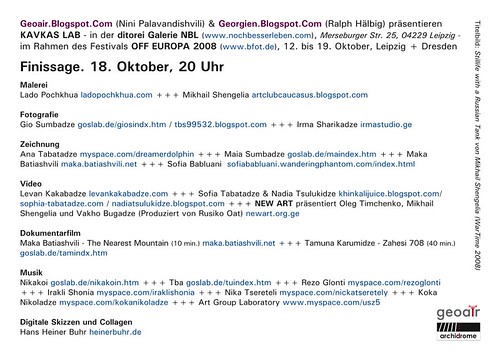
Exhibition of Salome Machaidze (delikatessenhaus.com) & Kavkas Lab with Georgian Artists (ditorei Leipzig)
Both exhibitions were organized for the Theatre Festival OFF EUROPA in Leipzig.


No comments:

Saturday, February 02, 2008

Exchange Academy

02-23 April 2008, Tbilisi, Georgia


Concept and organization GeoAIR, Georgia:
Freya van Dien (NL); Onno Dirker (NL): Sophia Tabatadze (NL/GEO)

Participating Artists:
Vahram Aghasyan (ARM); Can Altay (TR); Onno Dirker (NL); Ergün Erkoçu (NL); Peter Zuiderwijk (NL); Kote Jincharadze (GEO); Kote Sulaberidze & Nino Chilashvili (GEO); Sophia Tabatadze (Geo/NL); Lado Darakhvelidze (GEO).

Participatants from 'Archidrome' - Contemporary Art Archive, Georgia
Nini Palavandishvili; Ani Chorgolashvili; Lali Pertenava; Sophia Kilasonia; Sophia Tabatadze.

Participant from State Silk Museum, Georgia
Nino (Chuka) Kuprava

During three weeks in April 2008 a group of Georgian, Dutch, Turkish and Armenian artists created platform for exchange of information, brainstorm sessions, group and individual projects and research on and around the theme: contemporary art archive. This project was realized in collaboration with the team of Georgian Contemporary Art Archive ‘Archodrome’ and took place in the Silk Museum in Tbilisi. At the end of the working period of three weeks, final exhibition titled ‘Re-Opening of Silk Museum’ was opened for to public.

To avoid the known setting of the artists being invited somewhere distant place for short while, in order to produce quick work that concludes into an exhibition, of which not much remains after the departure of the artists, we decided to go the other way and change the setting. Suggestion was that the invited artists would work on a real problem that is present in Georgia, namely lack of archive or a base where the information and experience about contemporary art can be brought together. This information can have various forms, including collection and registration the projects like ‘Exchange Academy’. Thus the question was to think of ‘archiving’ the project like we were part of as a process of the project itself.

During the project public and art sector of Tbilisi were involved in the project through public lectures and talks by: Maia Mania (Geo); Khatuna Khabuliani (Geo): Nana Kipiani (Geo); and Nathaniel Mc’bride (GB).

Vahram Aghasyan (ARM) and Can Altay (TR)
organized artists’ talk in collaboration with ‘Archidrime’ ‘Archidrome’ - Contemporary Art Archive, Georgia


Project was support by:
Stroom, the Hague (NL); NCDO (NL); Step Beyond, European Cultural Foundation (NL).

Read More>>

Thursday, April 19, 2007

Dance Films Screenings

Program from 22 March to 24 May

Goethe Insitute Tbilisi, Zandukeli street 16

Nadia Tsulukidze organizes dance films screenings with disscusions, presenting concepts and ideas of Chorepgraphers from German 'Ausdrucks Tanz to 'Tanztheater', American Modern and Postmodern Dance.


Monday, April 02, 2007

Onno Dirkers residency in Tbilisi.

Cultural Agenda Tbilisi, project by Onno Dirker, design Nini Palavandishvili


------------------------------------------------------------------------------------


  • Tape to mark an area for the project 'A home for the ones without a roof' (Huis van daklozen)
Between the 4th of april and the 12th of may the Dutch artist Onno Dirker did individual residence in Tbilisi. GeoAIR invited the artist because of his strong engagement with and interesting projects about societal issues. For those of you that read Dutch: www.dirker.nl & www.atelierveldwerk.nl When Onno will be posting his experiences in a blog that you can access through the GeoAIR blog. You can download a pdf file with documentation of his projects in English HERE.

Onno Dirker is interested in ‘situations under pressure’ and the position art can take in these situations. Some of the themes and methods he works with are: the sociology of urban design, the relationship between east and west, human routines, cultural and urban analysis of neighbourhoods through the perspective of art. His work and way of working is engaged and enthusiastic and he has realised many successful projects. The Georgian context suits Onno Dirkers interests and we think that his energetic and engaged attitude will lead to a fruitful residence.

Sunday, March 11, 2007

BlogShop

'The BlogShop’ 9 November 20:00, location: Goethe institute Sandukeli Str. 16.

During the Art Caucasus there has been lot of talks about networks, art off course, idea's about what kind of art projects Tbilisi needs, about the lack of a critical discourse in Tbilisi and many more related subjects.
A lot of these talks took place in kitchens or in restaurants etc. and usually in small groups of people. There was a lot of engagement in these conversations and good idea's being articulated. A subject that often came up is the a lack for a platform where this engagement and the idea's can be shared and several foreign visitors said: 'there is so little information to be found on the internet about the Georgian art scene'.
Together with the French art lover and professional website and blog user Audrey Bartis we have discussed the possibility of making a network of blogs connecting the Tbilisi/Georgian art scene and make it visible on the internet.

What is a blog?
A blog is a free place on the internet that anyone can crate and fill with images and text about whatever he or she wants to show on the internet. A lot of people use it as an alternative for a website because it’s for free and very easy to make, keep updated and link yourself to others that share your interests.

The 9th of November we organise a BlogShop in which we will show how a blog functions, how you can make one and how a group of blogs linked together can make the Georgian art scene more visible on the internet and contribute to the strengthening of a local and national network.

Hope to see you there.
Best regards,

The GeoAIR BlogShop team: Freya van Dien, Sandro Chaidze, Sophia Tabatadze and Nadia Tsulukidze.

Monday, January 29, 2007

Tamuna Chabashwili (Geo/NL), Artist's talk about PSWAR and 'Beauty Unrealized' project

PSWAR /www.pswar.org/ is a collaboration of the artists Tamuna Chabashvili (Georgia, 1978), Adi Hollander (Belgium, 1976) and theoretician Vesna Madzoski (Serbia, 1976) whose activities go beyond the usual notions of artists-as-social-activists, artists-as-producers, and artists-as-curators, blurring the borders between many roles assumed to be taken by the present-day artists. Their projects are based on research and include several levels: examination of collaboration and collective action, the possibility to use existing artworks as ready-mades, questioning of the existing exhibition formats, creating platforms for intimate and individual experience of the artworks and changing perception of the space.


Beauty Unrealized
A research project conducted by Public Space With A Roof
***


In the last few decades beauty has been a much disputed term. It has often been associated with things ornamental or decorative, while simultaneously becoming the buzzword for conservative critics who object to anything avant-garde. Perhaps because of this stereotypical understanding and misuse of the term, 'beauty' has all fallen out of favour within present art discourse. With this project, we want to underline that (produced) objects are equally important as 'social projects'. Since people have always communicated through objects in space and time, it is important to discuss the link between objects and ideas, or more specifically, between objects and the concept of beauty. Invited artists, composers, film directors and philosophers will explore the concept of beauty today within the scope of their own process of self-development and their own work. As a framework for the whole project, we created a special library in which visitors can enter and get lost in the world of thoughts, ideas, questions, possibilities, and puzzles.


For detailed information you can visit the PSWAR web site:
www.pswar.org


Tuesday, December 12, 2006

Kirsten Leenaars (NL), 'Dreams of others' 2006-07


Kirsten Leenaars:
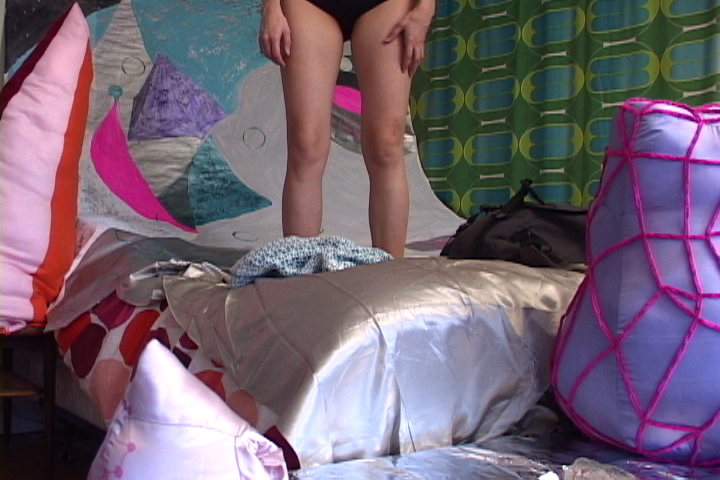
'In my work I explore how identity is constructed, how we look at ourselves and consequently at others. As an artist I work mainly in video and photography. I am interested in how the camera can play an active role in the constitution of its subject, questioning my own role as an artist within the traditions of presentation and representation. I often use my work as a ‘platform’ for other people where they can perform themselves. In the project “We are our dreams of ourselves souls by gleams And each to each other dreams of others’ dreams” (May 2006)

I looked at aspirational dreams as imagined spaces where personal circumstance and desires intersect. I asked people about their aspirational dreams and in the end to play themselves in their dreams. The dreams are filmed in each participant’s own living room, functioning as the symbolic framework that defines each one of them. I used objects that were already part of the space and used painted backdrops to assist in the execution of the dream. The dreams in this project are my translations of their dreams into video. I would like to develop a Georgian addition to this work. It is especially exciting to me to develop the counter part for my project in a nation that is going through a time of transformation. Now that new opportunities have opened up and old safety nets are disappearing I think it is particularly interesting to ask people about their aspirational dreams. I am very curious as to how the Georgian dreams will relate to those of my American participants, living in the so called ‘land of opportunities’. The Georgian addition to my project will be shown in Chicago at Gallery 400 in March 2007'.

For detailed information please visit: www.kirstenleenaars.nl

Tuesday, November 21, 2006

Rosell Heijmen (NL), 'The Very Temporary Contemporary Museum', 2006-07


At the end of 2006 I visited Tbilisi in order to start preparations for a publication about Arts and Culture in Tbilisi, in collaboration with GeoAIR. As a guest in Goethe Institute I was invited to make an exhibition in this period. The first step was to talk to young artist about their art-practice and the possibilities to show their work, hoping to see a lot of work in the process. Soon it became clear that the only possibility to see work by young artists is through looking in a catalogue, magazine or visit the artists in their home. This was my third visit to Tbilisi and unfortunately during all of these visits, I was not able to see the works of fellow (living) artists in an exhibition context. However there are a number of very interesting initiatives, art-collectives and persons that try to change the situation and focus on developing their works. I was lucky to have met a number of artists through GeoAIR and because of a prior project in Tbilisi called 'Georgia Here We come' (with an exhibition in the National Art Center that unfortunately seized to exist) in Spring 2006, that enabled me to get some insight in the Georgian Art scene.

There are a great number of museums in Tbilisi, most of them have an exceptional collection, a beautiful building, a large staff, and a lot of free space. Next to these exhibition spaces there are a number of private owned Galleries. None of the exhibition spaces offer contemporary artist a place to experiment, because there is no focus on modern art and the actual space is to be left intact. A few of the bigger museums are being renovated. In Tbilisi renovation can mean a number of things: The national museum on Rustaveli is indeed being renovated, new walls, new floors, new light, new division. It can also mean simply closing a part of the museum and leave it unused for a long period of time. The only 'lively' exhibition spaces and spaces for workshops, lectures and discourse seem to be foreign institutes like The British Council and The Goethe Institute. However their policy is to promote and develop their specific culture, respectively United Kingdom and Germany, it is mostly artists from these countries that have a chance to work there.

There are a lot of empty buildings and a lot of empty space in the museums in the city and there are a lot of plans to realize a contemporary art-space in Tbilisi, however the buildings will probably remain empty for a long time. A lack of flexibility and willingness (support through facilities, permissions etc.) from the part of the city council, the Government and the institutions make it very difficult for the artist to follow through on developed initiatives to realize serious projects without financial means. There is a lot of concern, talk and frustration about the situation, but due to lack of financial means and difficulties in working together, a place for showing, meeting and discussing, seems to be far away. There is hardly any government support, there is practically no art-market or government assignments for contemporary artists.

In contrast to the absence of a functioning presentation space, there are a few very interesting magazines that focus on contemporary art, photography, design, fashion, music, architecture and literature called Anabechdi, Hot Chocolate, a periodical by AIRL, and Loop'A. The magazines offer alternative possibilities for artist and designers to show their work. The first three magazines are in Georgian only, which is a pity for non-Georgians to get an insight in the Georgian contemporary art-scene.

In the Goethe Institute I wanted to show this situation and make a work in-situ. I ended up showing and feeling the situation, by experiencing some difficulties involving making an exhibition. Together with Lado Darakhvelidze and Giorgi Tabatadze I work on an installation based on the reality for artist to develop their art-practice and the lack of exhibition space. We divided the space in a classical museum space and two small museums. The classical space showed pictures of the interiors, taken in all the major museums and other art-spaces in Tbilisi. In the two small spaces Lado Darakhvelidze and Giorgi Tabatadze made a translation of their exhibition possibilities, they showed their work as it actually can be seen; in their house. By making this exhibition I was confronted with the Georgian reality. Until this time I did not actually understand what it is to deal with bureaucracy and hierarchy. The coarse of action is different, you need a different mind-frame to realize an exhibition especially in a short time frame. Even in the German Goethe Institute flexibility and support was hard to find. In order to get something done, even small things, heaven and earth were to be moved. The invitation to make this exhibition was there, but it seemed like an actual interest and commitment to realize this exhibition was absent. After having started to build the exhibition it became clear that the institute's interest was in a formal exhibition, framed pictures an occasional sculpture, no sound, no work, no fuss, nothing exceptional. With a small budget, a good concept an actual space, and a cooperating staff one should be able to work magic. With a good concept, an actual space, a small budget, and an unwilling director, everything works a lot slower and takes a lot of energy, creative process stops right there.

At the same time, Tbilisi art-scene is interested and interesting.
Whenever there is a exhibition or an action, there is a large group of visitors, big interest by the media and a lively discourse. For me this goes to show that the so much desired contemporary art space is of utmost importance for visitors and artists and it will work. With this potential and a lot of work remained unseen, it's not obvious why this space doesn't already exist, one could imagine that an unused building, made available by the city council, could easily be transformed.

Monday, November 06, 2006

Jasper van der Made

In February-March 2006 Jasper van der Made (NL) stayed in Tbilisi. During his stay he made the work Coca-Colonization which was shown in the Gallery Didi in Tbilisi.


Coca-Colonization

Friday, October 27, 2006

ABOUT: Caucasus Biennale Declaration (18 – 22 October, 2006)


By Nathaniel McBride

Much of the best work at Art Caucasus Declaration, Tbilisi’s prolegomenon to its first biennale next year, was to be found in Teppanyaki, a group show held by students and teachers from the city’s Art Academy. Here the exhibiting artists had agreed to produce all their work, in the manner of sushi chefs, on the opening night and in the presence of the gallery audience, thereby placing upon themselves tight restrictions of space, time and material. The most successful pieces worked through, rather than in spite of, these limits, making a virtue of simplicity, exploiting obvious affinities with performance and employing an aesthetics of the bodily trace or imprint. George Kevle’s Three Stains consisted of three abstract forms painted directly onto the gallery wall using his own blood mixed with that of an AIDS sufferer’s; the sense of vague apprehension this produced seemed to offer a modern substitute for the ‘aura’ that Abstract Expressionist painting once sought to achieve through purely formal means. In Through my Mouth, Giorgi Marr stuck pieces of chewed chewing gum to the wall in four rows extending from floor to ceiling, thus turning the decorative coloured candy into something simultaneously attractive and repulsive, its bright hues and fragrant scent contrasting with an awareness of the litres of spit and many man-hours of mastication were required to fix it there. Elsewhere, Elene Naveriani and Vajiko Chakhiani gave performances that produced a steady accumulation of lipstick prints and cigarette butts respectively. All these works spoke of monotony, but a monotony measured out in a series of tiny pieces or traces of a body slowly expended or used up, each one becoming a metaphor of gradual and inevitable physical dissolution. Thus their apparent playfulness often concealed a deeper seriousness - an underlying awareness of life’s finality, and the insistence upon this awareness as a precondition to being properly alive.

This aesthetic of the body’s trace was developed the following week in two performances at Tbilisi 3: Let’s Stay Alive til Monday, a group show of western and Georgian artists organised by the Swiss curator Daniel Baumann. Gela Patashura’s Untitled, in which the artist sat in a steam-filled glass cube writing messages on its walls that were almost instantly effaced by condensation, enacted a recurrent theme in Georgian art - the failure of communication, where the artist’s repeated messages to the ‘outside world’ are either lost, ignored or wilfully misunderstood. Kevle’s piece for this show involved him extracting half a litre of his own blood and then inviting a curator and a critic to cover the wall behind him with it. The blood was smeared in outline around the artist’s cast shadow and then outwards in a growing red aura that literally traced his absent presence on the gallery wall. The symbolism of the artist’s blood being manipulated by two traditional hate figures of the art world was lost on no one: more interesting, perhaps, was the reaction of a public still relatively new to performance art. The act of making oneself vulnerable is always also an aggressive one, and reactions to this aggressiveness naturally varied. But even the most hostile seemed to acknowledge its inherent attractiveness, in the guilty enjoyment of a shared complicity and the illicit participation in a collective guilt.

......................................................................................

By Aleksandra Galkina

Казус биеннале

Казус биеннале
В октябре этого года в Грузии состоялась международная выставка «Кавказская биеннале – Декларация», которая заявлена составной частью Кавказской биеннале, планирующейся в 2007 году. Лейтмотивом многих работ, представленных на выставке, так или иначе, является «изменяющийся мир» в смысле его социополитической трансформации во времени. Однако за немногими исключениями искусство, представленное на выставке, похоже на то многое, что сейчас представляется как «искусство постсоветских стран». Претендующее на роль современного и имеющее амбиции в области сложившегося художественного контекста, оно зачастую спекулирует на «базовых ценностях» (национальных, религиозных), тавтологично размещая себя на периферии глобального художественного процесса. Но это впечатление – скорее вина организаторов таких выставок, недостаточно внимательно и вдумчиво подходящих к работе с локальными художественными контекстами.
Это уже не первый опыт «больших проектов» на Кавказе. Автором и организатором «Декларации» является Южно-Кавказская региональная Ассоциация «Арт-Кавказ» (Грузия, Армения, Азербайджан), 3 года подряд проводившая международные выставки-ярмарки, и декларировавшая тогда своей целью «формирование арт-рынка Южного Кавказа и создание сильной и координированной структуры арт-бизнеса в регионе». Факт биеннале - в большей степени факт государственного значения. Таким образом, инициатива, изначально нацеленная на развитие арт-туризма, обретает вполне завершённую форму идеологического проекта.
Постепенное включение в мировой художественной контекст стран т.н. постсоветского пространства давно уже очевидная тенденция. На выставке в Тбилиси было представлено в основном искусство стран Южного Кавказа (а также Украины, России, Германии, Турции и Ирана). Выставка состояла из нескольких частей – непосредственно экспозиции в трёхэтажном здании Детской национальной галереи, конференции на тему «Искусство в изменяющемся мире» и мастер-классов иностранных кураторов и художников. В частности, небезынтересной была лекция куратора Антонио Джеуза, посвященная русскому видео-арту, проведённая в местном Гёте институте. На примере работ Бориса Юхананова, «Новой Академии» («Пиратское телевидение»), группы «Синие носы», художников Гии Ригвавы («Они всё врут»), Антона Литвина, Анны Ермолаевой, КД, а также редких и мало кем виденных даже в Москве видео Андрея Монастырского «Разговор с лампой» Антонио проследил развитие этого жанра в России.
Экспозиция в Детской национальной галерее была поделена по странам, представленным художниками-участниками и тематическим проектам. Один из залов занимала выставка “Экотопия, современное искусство и экология в Закавказье”. В ней приняли участие художники из Грузии, Армении, Азербайджана и Германии. Пафосом выставки должен был стать прецедент сотрудничества современного искусства с экологией. Как объясняет искусствовед Хатуна Хабулиани, экологические темы в традиционной грузинской живописи – предмет эстетизации, «ландшафты и натюрморты служат колористическим задачам», а для советского периода природа была скорее безопасной темой, где авторы чувствовали себя защищённым, избегая спорных вопросов (классические примеры живописи Пиросмани и концептуальных ландшафтов художника Давида Какабадзе). Выставка включает как отдельные работы, так и запись интервью с художниками, комментирующими свои работы и предлагающих собственные проекты по улучшению окружающей среды властям. Нино Сехниашвили озабочена проблемой растущей радиации, она предлагает измерить степень радиации в художественных галереях разных стран и сравнить её. Художница Софо Табатадзе говорит о мусорных свалках, которые в Грузии можно встретить и у фешенебельных вилл, владельцев которых не смущает такое соседство и им безразлично, что творится за стенами их владений. Ещё один респондент фильма – скульптор Мамука Самхарадзе -обеспокоен недопустимой, по его мнению, близостью озера Лиси (Тбилиси) с жилыми кварталами. В фильме есть фрагмент его перформанса - «медитации в танце» у этого озера. Как отметила Ева Хачатрян в сопроводительном тексте к армянской части экспозиции «Экотопии», остаётся вопросом то, может ли искусство выполнять «инструментальную» функцию по отношению к социальности, или нет.
В рамках этих рассуждений интересным представляется проект, представленный на выставке в Тбилиси грузинским куратором Георгием Кевле. В прошлом году на очередном «Арт-Кавказе» им была организована выставка «Другой Кавказ». Сейчас он представил наиболее удачную экспозицию во всей «Декларации». Она называется “Teppanyaki”. В каталоге, составленном, кстати, целиком на английском языке, в духе «а почему нет» дано краткое объяснение, содержащее цитату из википедии (сетевой открытой энциклопедии). Teppanyaki – японская кухня, в которой всё готовится на специальной большой сковороде. В середине 20 века Teppanyaki, популяризированное в Америке одной сетью ресторанов, приобрело новое значение – так стал называться зрелищный процесс приготовления блюда в японской кухне. Это и имелось в виду авторами. Здесь можно угадать иронию над «шутовским» поведением страны-периферии перед центром-монополией в политике (культурной, в частности).
Все работы в экспозиции - результат перформативных действий на месте, что концептуально перекликается с её названием. По технике исполнения все они отличаются лаконичностью и простотой. На одну из стен грузинским художником Melano было нанесено крупное пятно нефти, формой напоминающее цветок, – работа “Oil flower”. Следом на двух расположенных по горизонтали выступающих из стены прутах было натянуто предварительно смоченное в зелёнке и затем скрученное во много раз полотенце. Площадь вокруг объекта осталась забрызганной зелёнкой (Condition 8, художник Gago, Грузия). Другая работа Stain 1,2,3 – три небольших пятна бледно-красного цвета – в технических данных которой указаны «кровь, заражённая СПИДом, кровь овцы, пятно краски» (Giorgi Kevle, Грузия). Работа Through my mouth – 4 параллели вертикальных рядов разноцветных жвачек, каждую из которых художник Giorgi Marr разжевал и приклеил к стене.
В целом проект Teppanyaki по форме вполне убедителен. Однако общее впечатление от выставки «Кавказская биеннале - Декларация» замутняется экспозиционной невнятностью. Значение подобных выставок в локальном и международном контекстах если не иллюзорно, то сомнительно. Безусловно, выставка «Декларация» и заявленная на следующий год Кавказская биеннале должны оказать некоторое влияние на ландшафт местного культурного контекста (туристический интерес к региону вырастет наверняка), но на международный рейтинг художников – вряд ли.
Александра Галкина
2006


.

Александра Галкина

2006

..........................................................................................

By Freya van Dien


The Art Caucasus 2006; Caucasus Biennale Declaration. What’s in a name?


If I were to ask someone who had neither seen nor heard of ‘The Art Caucasus 2006; Caucasus Biennale Declaration’ what kind of project or presentation they think it could be, what would they say? What do the words ‘art’, ‘Caucasus’, ‘biennale’ and ‘declaration’ stand for?

Let me start by tackling the most difficult one: art. Art, to me, is a form of human expression that represents or presents this ‘stranger than fiction’ world of ours in ways that make us realise the immense diversity in which it can be experienced. Art also shows us the uniqueness and talents of human beings who choose the life of an artist and put themselves under the pressure of always questioning oneself and the world around them in order to keep their art alive and relevant. It is these are two notions of art that keep me interested and make me want to go see exhibitions.
‘Art’ and ‘Caucasus’ might stand for a project representing the artistic production and dynamics of the Caucasus to the Caucasus and the international public and press. It is a project about and by the Caucasus art world. A co-operative effort like this is a valuable thing. It gives the people involved the chance to discuss and decide together ‘what is Caucasian art when our different views come together?’ Like all countries and regions in the world the Caucasus also questions and develops its culture and relationship to others in order to keep its head above water in the globalizing world. In places like the Caucasus especially, where you find what I call ‘cultures under pressure’, it is important to have a lively public and civil discussion about cultural development. An exhibition of Caucasian art can contribute to this. It is a project that is accessible to the public and gives the Caucasian art world, the international art world and the general audience the possibility to meet and discuss together.

A Biennale Declaration? What do these words mean? Does it declare the coming of a Biennale in the future? Or that one is starting right now? In either case it declares the existence of a Caucasus Biennale; an internationally important show where the Caucasus and the international art world meet. That has proven to be a great tool for showing the international community what you are made of. If you want to be visible this is a well known strategy to use. We also know it’s a strategy everyone uses. There will be about 9 Biennales and 1 Documenta going on in the summer and autumn of 2007. Is a Biennale still an effective way of presenting oneself or is it just a fancy word everyone knows, dangerous because it risks making claims for itself it cannot deliver. It is up to artists, curators, theorists and other people involved in the Caucasus art world to decide if the model of a Biennale is the right one to invest in the Caucasus art world and its relation to the international community.

Having said all this, let’s look at what Art Caucasus 2006, Caucasus Biennale Declaration, besides its name, really meant.
I made my visit on the last day. On the first floor, behind a closed door, I found an unlit presentation space with the remains of performances done on the opening evening by art academy students. Part of the plan was to show each performance on monitors afterwards, but this failed owing to lack of funds. On the second floor the Ecotopia project, completed at end of 2005 and the beginning of 2006 with some good work by artists from Germany and the Caucasus, was crowded into the exhibition space. I walked into another room, which was 70 percent empty and showed, in two corners, work by a Georgian artist and by an Armenian graphic designer. In another corner there was also a grand piano covered with papers and a bucket and some fabric. For a minute I wondered whether this was an art piece but it was just some stuff left behind. On the way to the third floor I passed a Kodak advertisement which made me feel as if I was entering the ‘office zone’ where aesthetics and disturbing elements, for as far as anyone had paid attention to this on the previous floors, really did not matter anymore. I was wrong: this was also an exhibition floor but at the end of the last day most pieces using electricity were switched off. By now I had had it and did not feel like looking for any more art. It was a pity, because looking at the catalogue there were some interesting pieces there. This feeling of ‘why bother?’ had also stopped some artist friends of mine to go through the whole exhibition.

On the level of art it was a collection of unrelated and badly exhibited projects. It felt as if the exhibition was put together by someone who does not know how to treat an art piece or a combination of art pieces with proper respect, as if it did not matter what and how things were shown as long as something was shown. What was shown here surely did not live up to any expectations of an exhibition representing art from the Caucasus and I won’t even go into what is necessary to be taken seriously by the international art world if one organises an international Biennale.

Over the last 6 months I have been following the development of this year’s Art Caucasus from a distance. I know the organisation has made an attempt to involve several people from the Georgian field of art. I also know people dropped out at a certain point because they felt that their ideas were not being listened to and that the organisation was taking them over without involving them. I wonder what happened to the contacts the organisation had outside Georgia. The guests I’ve talked to have all expressed some level of disappointment about, for instance, their presentations not being announced, or unclear appointments about payment and formal arrangements.

If you want an exhibition representing the Caucasus you have to organise a democratic process for the development of the concept and the selection of the works. Except for a long list of names in the catalogue I have not seen many signs of a successful democratic process behind this project. What I also have not seen is any form of public critical discourse alongside this project, and in my opinion a healthy project needs and should embrace criticism. What I think is necessary at this phase of the region’s cultural development is the guts to experiment, take risks and face consequences when they cross the path of saying what you want. Democratic cultural development should be anything but cramped, and that is exactly the general feeling of ‘Art Caucasus 2006, Caucasus Biennale Declaration’ gives me; cramped. What could be behind this? Fear of losing face? Nepotism? Naivety? I don’t know, but in this case it seems that the Georgian ability to work together with people from different backgrounds, and their famous sense of hospitality, got lost somewhere between management muddle and an overemphasis on prestigious phrases like ‘Art Caucasus 2006, Caucasus Biennale Declaration’.

Tbilisi 27-10-'06